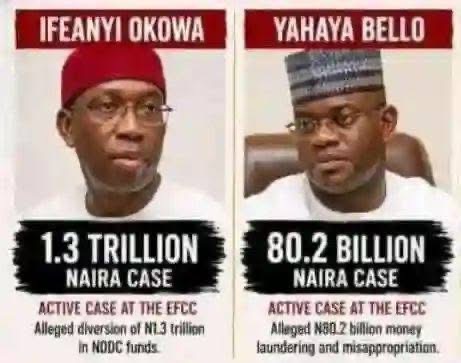
As a political analyst, the puzzle isn’t mysterious—it’s a feature of Nigeria’s patronage politics, not a bug.** The APC’s decision to clear and celebrate former governors Ifeanyi Okowa (Delta) and Yahaya Bello (Kogi) as senatorial candidates, despite high-profile EFCC scrutiny, perfectly illustrates the gap between anti-corruption rhetoric and the raw logic of power retention in Nigerian elite circles.
The Core Contradiction
APC campaigned and governs under a banner of fighting corruption. Yet the party has facilitated paths for these figures into the Senate, where legislative privileges and constitutional protections offer breathing room.
This isn’t subtle. Nigerians see EFCC seizing Okowa’s passport over alleged diversion of massive funds (around ₦1.3 trillion claims tied to derivation and federation accounts) while the same system greenlights his senatorial bid.
Bello faces ongoing trials for alleged N80-110 billion laundering/misappropriation, with courts rejecting jurisdiction challenges as recently as mid-2026—yet he cruised to a landslide APC primary win.
The party isn’t “fighting corruption” in a vacuum; it’s managing a political ecosystem where former governors are big men with networks, godfathers, and resources that deliver votes, delegates, and stability in their zones.
Clearing them signals: loyalty and utility to the party matter more than unresolved probes, especially when those probes target defectors or opposition figures who can be co-opted.
Okowa, a PDP heavyweight, entering APC folds fits a broader pattern of absorptions.
Senate as Safe Haven: Immunity and Precedent
Section 308 of the 1999 Constitution grants immunity primarily to sitting executives (President, VP, governors, deputies), not legislators.
However, senators enjoy parliamentary privileges under the Legislative Houses (Powers and Privileges) Act—protection from civil/criminal proceedings for things said or done in official duties, plus practical delays, influence over agencies, and the political capital to negotiate or stall cases.
Many ex-governors have historically used the Red Chamber as a soft landing: it provides national platform, constituency projects, and cover while cases drag on (Nigerian justice is notoriously slow).
The precedent they are setting is sharp and dangerous. Allowing this normalizes a script: loot state resources → face probe post-tenure → defect or align with federal power → secure legislative ticket for insulation.
Tomorrow’s governor or official will cite Okowa and Bello explicitly. It erodes deterrence. EFCC appears selective or weaponized—aggressive on some, toothless or delayed on party assets—fueling cynicism that it’s more political police than independent arbiter.
The passport seizure on Okowa for “medical treatment” while pushing him toward Senate creates an absurd visual of a system at war with itself.
Broader Legacies and Sociopolitical Realities
This is uniquely APC—Nigeria’s political class across parties treats public office as extractive enterprise with low accountability. Immunity clauses (originally for uninterrupted governance) have become enablers of impunity.
Public outrage is loud but fragmented; voters often prioritize ethnicity, incumbency, or “stomach infrastructure” over probity in primaries and elections.
Legacies created:
– Institutional mockery: Undermines EFCC credibility and global perception. International observers note selective enforcement amid Nigeria’s corruption rankings.
– Elite impunity: Entrenches a revolving door where accountability is performative. States like Delta and Kogi, with development deficits despite resources, see their former leaders rewarded.
– Democratic erosion: When parties prioritize big players over clean slates, it discourages competent outsiders and signals to youth that “steal and move to Senate” is viable.
– Precedent for capture: Future cases will be politicized—“Why him and not them?”—weakening rule of law.
The puzzle resolves when viewed through incentives: parties need winning machines more than moral consistency.
True reform requires constitutional tweaks (narrowing immunities), independent judiciary/EFCC funding, transparent primaries with integrity clauses, and voter punishment at the polls.
Without that, this is rational elite behavior in a low-trust, high-stakes system.
The world watches, and ordinary Nigerians bear the cost in eroded trust and missed development.
History will record it as continuity of elite self-preservation, not transformative governance. Whether APC (or any party) can break this cycle depends on pressure from below, not rhetoric from above.
–Pamela O.
Political Analyst and Commentator
About the Author