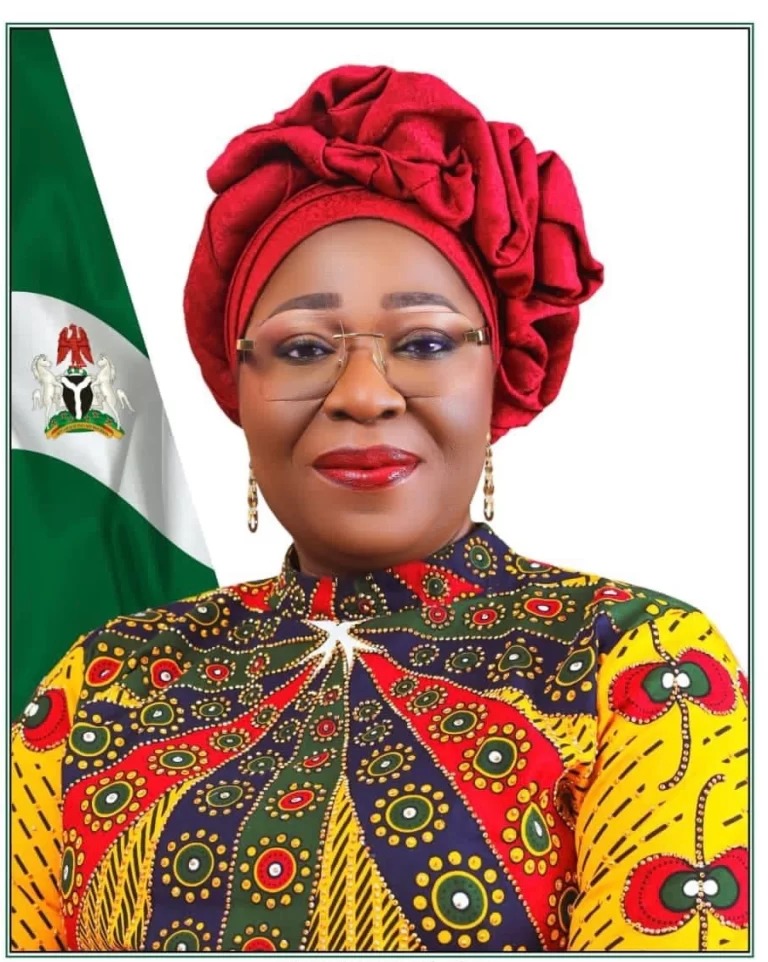
When Senator Dr. Akon Eyakenyi eventually leaves office, her most durable contribution will not be a single project or speech.
It will be a change in what Nigerian politics treats as possible for women at the second-highest seat in a state.
Nigeria has never elected a female governor. Female deputy governors remain a small minority—nine of thirty-six at last count—and many of those who came before her entered the office by appointment after a vacancy, not by winning a joint ticket with a governor.
Eyakenyi is different. She is Akwa Ibom’s first “elected” female deputy governor. That distinction is the ceiling she shattered. An appointed woman can be explained away as a temporary fix. An elected one cannot. She ran, she was chosen, and she has occupied the office in ordinary political time, not as an emergency substitute.
That matters because the deputy governorship in Nigeria is often dismissed as ceremonial. Eyakenyi’s record undercuts that cliché in a particular way. She did not arrive as a novice who needed the office to invent a résumé. She arrived as a former classroom teacher, state commissioner, federal minister of lands and housing, polytechnic council chair, and senator.
The office therefore did not have to prove that a woman could hold it. It only had to show that a woman with a full career behind her could hold it without drama, without rivalry, and without being reduced to a gender symbol.
Governor Umo Eno has publicly credited her with the kind of support that keeps an administration focused—peace, loyalty, continuity.
That is not the language of a spare tyre. It is the language of a functioning number two.
For women who come after her, the practical lesson is more important than the historic first. Eyakenyi’s path was long, institutional, and unglamorous: education service, boards, a ministry, the Senate, then the ticket. She did not leap from activism into executive power.
She accumulated competence that party structures could not easily dismiss. Future female running mates will be measured against that standard—whether they can be sold to voters as partners in government, not as decorative balance.
In a country where women’s share of elective office still hovers around four to five percent, that is a higher bar than symbolism, and a more useful one.
There is also a state-level institutional legacy. Under the administration she serves, Akwa Ibom has claimed about 40 percent female representation in political appointments—above the old Beijing 35 percent benchmark—and women now sit as chief judge, head of service, commissioners, and local government chairs.
Eyakenyi has been the public face of that argument: that inclusion is policy, not favour. Whether those numbers survive the next government is an open question. What she has done is make it harder for a successor to pretend that women in executive space are an experiment. The experiment already ran. The state did not collapse. The governor still governed.
Her limitation is the same as the office itself. A deputy governor does not set the agenda; she amplifies it. She will not leave a personal statute book or a signature megaproject that history will attach only to her name. That is honest analysis, not diminution. The ceiling she broke was not the governorship.
It was the belief that a woman could only reach the deputy’s chair by appointment, accident, or tokenism. She reached it by election, after decades in the system, and then performed the job as a loyal, experienced partner rather than a novelty.
That is the inheritance for the next female deputy governors: not a myth of effortless breakthrough, but proof that the ticket can be won, the office can be held without apology, and competence plus loyalty can outlast the old suspicion that a woman in that seat is either a spare part or a threat.
The glass is cracked. The next generation still has to walk through it. She showed that the door exists.
Pamela O.
Political Analyst and Columnist
About the Author