

In the swirling vortex of Nigerian politics, where alliances shift like desert sands and power plays unfold in real-time, few moments capture the zeitgeist quite like the recent expulsion of Nyesom Wike from the Peoples Democratic Party (PDP).
On November 15, 2025, at the party’s national convention in Ibadan, the PDP’s National Executive Committee delivered a seismic blow, ejecting the former Rivers State governor, alongside allies like Ayo Fayose and Samuel Anyanwu, for alleged anti-party activities.
This wasn’t just housekeeping; it was a declaration of war against internal saboteurs, a bold reclamation of the party’s soul ahead of the 2027 elections.
But here’s the irony: the spark that ignited this firestorm may not have come from PDP’s own war chests.
It came, unwittingly, from an unlikely source—Lieutenant Ahmed Muhammad Yerima, a mid-level military officer whose viral confrontation with Wike has demystified the self-styled “political warrior” and handed PDP the morale boost it desperately needed.
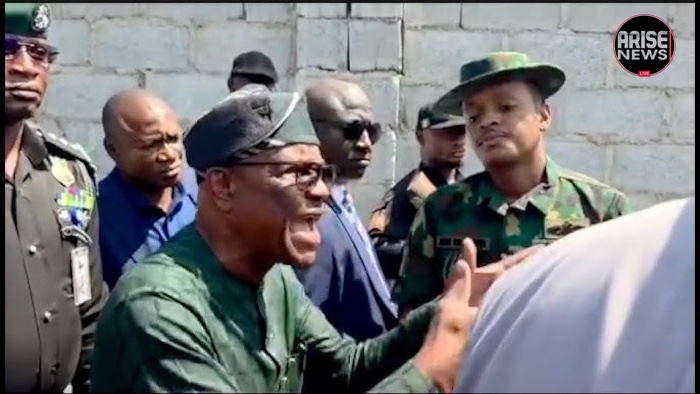
To understand this twist, rewind to the now-infamous incident in Abuja’s Federal Capital Territory (FCT), where Wike, as Minister of the FCT, clashed publicly with Lt. Yerima over a routine demolition exercise.
Videos circulating on social media captured the raw tension: Yerima, stationed at the site, refused to budge on orders from his superiors, even as Wike—known for his volcanic temper and unyielding bravado—demanded compliance.
What started as a bureaucratic tussle escalated into a national spectacle, with Yerima’s calm defiance (“I will not disobey my commander,” he reportedly stated) exposing cracks in Wike’s armor.
For a man who has bulldozed opponents from the Rivers State House of Assembly to the PDP’s national secretariat, this was no small humiliation.
It played out in full view, with eyewitnesses and smartphone footage turning Yerima into an overnight folk hero, especially in northern circles where Wike’s influence has long been a thorn.
Yerima, by all accounts a dutiful officer thrust into the spotlight, didn’t set out to topple political giants. His stand was rooted in military protocol—loyalty to chain of command over civilian bluster.
Yet, in doing so, he achieved what PDP’s internal hawks had struggled to do for years: prove that Wike, the indomitable “Mr. Projects” who once boasted of defeating godfathers like Rotimi Amaechi, is not invincible.
As one X user put it succinctly amid the convention buzz: “Seems the star boy Yerima has demystified Wike.”
Another echoed the sentiment: “If not Lt. AM Yerima where PDP from see kind courage.”
In a party fractured by Wike’s G5 machinations and his open flirtations with the APC—recall his role in undermining Atiku Abubakar’s 2023 bid—these words resonate like a battle cry.
Wike’s expulsion isn’t happening in a vacuum. For months, PDP chieftains have accused him of destabilizing the party, from revoking the PDP secretariat’s land allocation in Abuja to handpicking and ousting five national chairmen at whim.
His “moles,” as critics derisively call them, have burrowed deep: Samuel Anyanwu, the reinstated national secretary whose loyalty to Wike allegedly blinded him to party discipline; Ayo Fayose, the Ekiti firebrand whose barbs against PDP leadership mirrored Wike’s playbook; and a cadre of others who’ve prioritized personal fiefdoms over collective revival.
Yerima’s episode provided the psychological edge—the proof that even a “self-acclaimed Nigeria politics warrior” can be challenged and made to back down publicly.
It transformed whispers of rebellion into roars of action, emboldening the convention delegates to wield the expulsion hammer without the usual hand-wringing over “reconciliation.”
This purge is PDP’s muscle-flex: a signal to 2027 aspirants that the party won’t tolerate fifth columnists any longer.
Wike, once the PDP’s golden boy who amassed his fortune and fame under its umbrella, now faces the ultimate irony—booted by the very institution he sought to bend to his will.
His moles, like Anyanwu and Co., must follow suit; their tenures were always conditional on loyalty to the umbrella, not to a single man’s ego.
As Wike himself once quipped about rivals like David Mark and Atiku, inconsistency breeds irrelevance—what’s good for the goose should be good for the gander.
Yerima, for his part, emerges as an accidental architect of change. His defiance wasn’t a partisan shot but a reminder that power, no matter how loudly proclaimed, yields to principle when cornered.
PDP, seizing this momentum, has booted Wike not just from its ranks but from its narrative. The warrior has been challenged—and, for now, vanquished.
In Nigerian politics, where today’s ally is tomorrow’s exile, this could be the morale transfusion that turns PDP from a fractured relic into a 2027 contender.
Yerima didn’t plan it, but his stand has rewritten the script. And for that, the party owes him a quiet nod of thanks.


