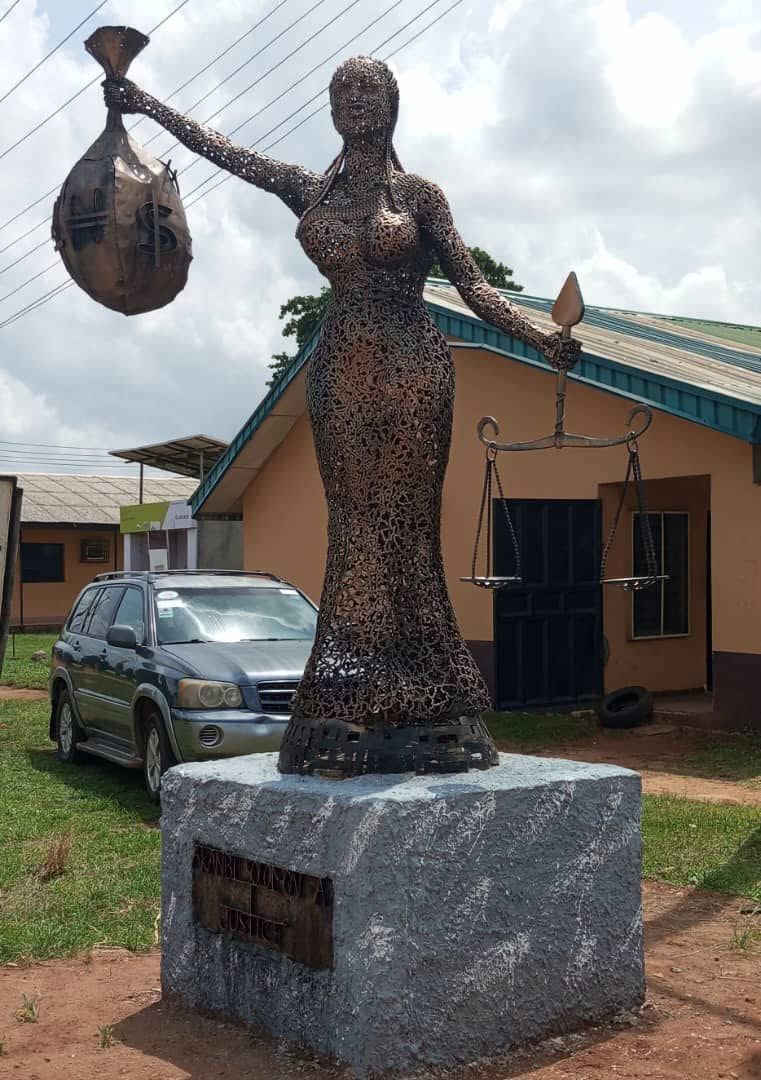
*Nigeria's Modern-Day Justice System as depicted by a Fine Art student of the University of Benin, Edo State*
By AMECHI.P
Nigeria’s modern-day justice system has long been a subject of scrutiny and debate, often criticized for its inefficiencies, susceptibility to corruption, and failure to deliver equitable justice.
A fine arts student from the University of Benin in Edo State has poignantly captured these systemic flaws through a striking statue, symbolizing how monetary inducement overshadows moral justice in the country’s courts.
This artwork serves as both a creative expression and a bold commentary on the state of Nigeria’s judiciary, reflecting a broader societal frustration with a system perceived as compromised.
The statue, as described, portrays a justice system where financial influence reigns supreme, sidelining the principles of fairness and integrity that should underpin legal proceedings.
This depiction aligns with widespread reports and sentiments about Nigeria’s judiciary today. Corruption within the system is not a new accusation—cases of bribery, political interference, and delayed justice have been documented over the years.
The artist’s choice to emphasize money overpowering morality mirrors real-world instances where wealth and connections often determine judicial outcomes, rather than evidence or righteousness.
For example, high-profile cases involving powerful individuals frequently end in questionable rulings, fueling public distrust.
The University of Benin, located in Benin City, Edo State, is known for its vibrant arts community, and this student’s work draws on a rich tradition of using art as a tool for social critique. Edo State itself, with its historical legacy tied to the Benin Kingdom, has a cultural heritage that values justice and order, making the contrast between past ideals and present realities even starker.
The statue could be seen as a modern echo of the Benin Bronzes—artworks that once narrated the kingdom’s history and values—now repurposed to tell a story of decline in Nigeria’s legal framework.
This artistic representation also resonates with the lived experiences of many Nigerians. The average citizen often faces a justice system bogged down by bureaucracy, underfunding, and a lack of accountability.
Courts are overwhelmed, with case backlogs stretching years, while allegations of judges accepting bribes to sway verdicts are not uncommon.
The fine arts student’s statue, by placing monetary inducement at the forefront, underscores how these issues erode public faith in the judiciary, reducing it to a marketplace where justice is a commodity for the highest bidder.
Moreover, the artwork invites reflection on the broader implications for Nigerian society.
A justice system that prioritizes wealth over ethics perpetuates inequality, as the poor are disproportionately disadvantaged, unable to afford the “price” of favorable rulings.
This theme connects to ongoing national conversations about governance, accountability, and the need for judicial reform—issues that have sparked protests, legal debates, and calls for systemic overhaul.
In essence, the University of Benin student’s statue is more than just an artistic endeavor; it’s a mirror held up to Nigeria’s modern-day justice system.
By depicting monetary inducement eclipsing moral justice, the artwork encapsulates the disillusionment of a generation and challenges viewers to confront the uncomfortable truths about their country’s judiciary.
It stands as a testament to the power of art to provoke thought, stir dialogue, and demand change in the face of entrenched societal flaws.
About the Author