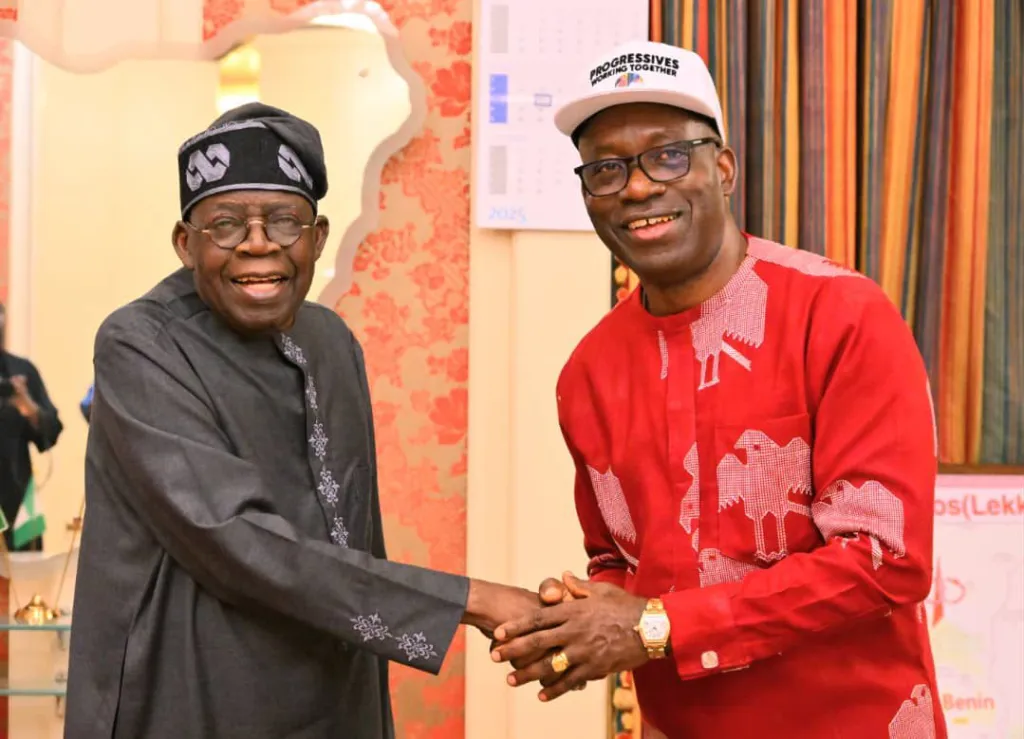
Governor Chukwuma Soludo’s Rainbow Coalition alignment with Tinubu, layered on sustained attacks against fellow Anambra son Peter Obi (NDC presidential candidate), has deepened a political rift that risks turning the 2027 vote into a statewide demonstration of grievance.
In a state where voters often speak with relative unity and are harder to sway with small inducements, this dynamic places APGA legislative candidates in the most exposed position.
Governor Chukwuma Soludo’s appointment as Anambra Coordinator on the APC Presidential Campaign Council, and APGA’s formal adoption of Tinubu while fielding its own candidates for Senate, House of Representatives, and State Assembly, was already a calculated dual strategy.
Soludo has defended it as pragmatic continuity—protecting APGA, securing federal projects for Anambra, and following a history of the party supporting the centre when it serves state interests.
The state party structure has echoed the line: Tinubu for President, APGA for the rest.
What has compounded the cost is the concurrent and highly visible campaign against Peter Obi.
The Anambra government has issued “betrayal alerts,” accused Obi of working to destroy APGA since he left in 2014, framed a vote for him and the NDC as a vote to kill the party, and urged supporters to resist him.
Parallel disputes over financial records and debts from Obi’s governorship have kept the exchanges sharp.
Critics, including APGA founder Chekwas Okorie, have described the posture as rooted in long-standing personal political grievances rather than pure governance questions.
Many residents and observers have viewed the intensity as unprecedented and counterproductive, especially when directed at a former governor who remains a significant figure among Ndigbo.
The Emerging Line and Voter Calculation
This combination—public attacks on Obi plus open siding with Tinubu—has been interpreted by a substantial section of Anambra opinion as Soludo choosing the centre against “their own.”
In a state with a history of relatively coherent voting behaviour (APGA’s long dominance, strong local ownership of the governorship, and resistance to easy external capture), such a perception can harden into collective pushback.
Anambra’s electorate is not among the easiest in Nigeria to move with modest cash or logistics alone; many families have independent economic means, reducing the effectiveness of classic vote-buying compared with poorer states.
Rigging is also structurally harder because of the state’s political culture and the tendency for outcomes to reflect a clearer local consensus.
The result is that 2027 risks becoming, for a critical mass of voters, less a pure policy or party contest and more a demonstration of which side they stand on.
Supporting the NDC presidential ticket (Obi) while rejecting or punishing the APGA legislative slate becomes a low-cost way to register disapproval of the governor’s posture without necessarily abandoning every local calculation.
NDC gains leverage from this dynamic precisely because it can position itself as the vehicle for that expression of grievance, especially if Obi’s national appeal resonates with residual Obidient sentiment and local pride.
Impact on APGA Legislative Contenders
Most candidates running under APGA for Senate, House of Representatives, and the State Assembly now carry the heaviest burden.
Their campaigns have traditionally drawn strength from the party’s identity as Anambra’s homegrown vehicle and from Soludo’s governorship coattails and control of local structures (including the recent local government sweep).
The dual strategy plus the Obi feud introduces several pressures:
– Brand contamination and voter rejection: The split-ticket message is already difficult to sell. When it is paired with visible hostility toward Obi, it becomes easier for opponents to frame APGA candidates as extensions of a governor who has “patched sides” against the state’s preferred figure.
In a state that often votes with a relatively clear collective voice, that framing can travel quickly.
– Resource and attention dilution: Party machinery and the governor’s influence are partly committed to the presidential effort and the anti-Obi messaging.
Candidates who relied on straightforward APGA mobilisation face a thinner or more contested environment.
– Selective insulation is limited: Senator Emmanuel Nwachukwu (Anambra South) remains relatively better positioned because of his by-election mandate, local scorecard in the Nnewi axis, and elements of personal rather than purely party-dependent appeal.
Even he is not immune if the broader mood hardens against anything associated with Soludo’s current posture.
Most other aspirants lack that buffer and will have to work harder to detach their candidacies from the governor’s national choices.
– Opposition opening: NDC and other forces can exploit the rift without needing to match APGA’s state machinery, simply by offering a clearer channel for protest voting.
Soludo’s calculation remains that federal goodwill and visible projects can still generate positive coattails and that APGA’s structural dominance will hold.
That is possible if development delivery is strong and messaging stays tightly controlled.
It becomes costly if a critical mass of Anambra voters treat the combination of Tinubu alignment and sustained attacks on Obi as a line that has been crossed, and use the ballot to demonstrate which side they occupy.
In a state where vote buying is less decisive and collective voting patterns have historically been clearer, the casualties of that demonstration are most likely to fall on those contesting under the governor’s party.
-Daily Buzzwire
About the Author