Screenshot
In the fevered scramble already under way for 2027, most Nigerian politicians are busy counting governors, recalibrating loyalties and mastering the language of “delivering states.”
President Tinubu, at the inauguration of his APC campaign council, referred to himself as “Governor Bola Tinubu” seeking a second term. Nyesom Wike warned campaign chiefs not to assume victory and pledged Rivers and the FCT.
The usual theatre of transactional politics continues.
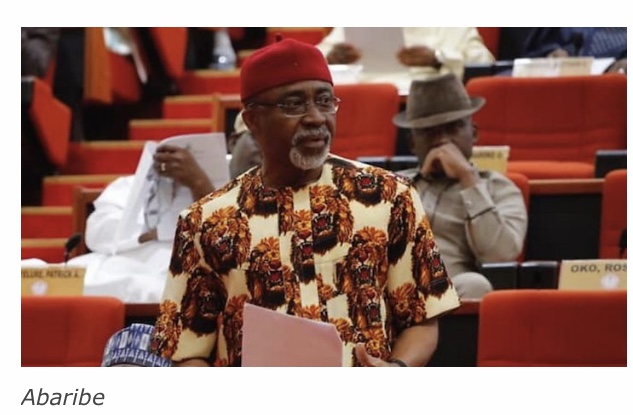
Against that backdrop, a short statement attributed to Senator Enyinnaya Abaribe cuts through with unusual clarity: Peter Obi is his only candidate for 2027. “He remains the best man for Nigeria.”
The declaration is noteworthy precisely because it is inconvenient. Abaribe is the Labour Party’s candidate for Abia South Senate; Obi is the presidential candidate of the Nigeria Democratic Congress, with Rabiu Kwankwaso as running mate. They are not on the same ticket.
Abaribe faces a crowded field of fourteen aspirants, each chanting the mantra “you have done your turn; give us a chance to do ours,” forgetting that a legislative seat is not about “Emi lọkan”. It requires competence, courage, experience and a willingness to speak truth to power.
As things stand, the Igbo cannot afford to lose one of the few bold voices they still have in the Senate.
Which of those aspirants has the courage to speak with the same boldness? Most will likely simply join the queue of transactional politics that dominates Nigeria today.
His constituents, seeing the tangible differences he continues to make both in community development and in his legislative work, have already used their votes to answer those aspirants. They cannot afford to lose him and are ready to return him massively in 2027.
He is a goldfish among ordinary fish, and Abia South is fortunate to have such an iconic and distinguished figure. He has no skeletons in the cupboard that would force him, like so many others, to hide behind ambiguous rhetoric. He speaks his mind clearly, no matter whose ox is gored.
There are already whispers that Governor Otti may eventually look in his direction as a possible successor capable of carrying on his legacies. But let’s cross our fingers and wait; until then, those whispers will only grow louder.
In the ordinary calculus of Nigerian politics, the prudent move would have been silence or a carefully worded statement about “the best opposition candidate.” He chose neither.
This is consistent with the man. Abaribe has never been a master of the art of political survival for its own sake.
As deputy governor of Abia under Orji Uzor Kalu between 1999 and 2003, he survived three impeachment attempts before resigning rather than continue in a position reduced to ceremonial humiliation.
In the Senate he has held key positions—including Minority Leader—yet has repeatedly taken positions that cost him political capital.
In January 2020, during a debate on national security, he told his colleagues that Nigerians had elected a government, not service chiefs, and that the APC administration had failed.
He reminded the chamber of the 2015 campaign promise that the government should be “stoned” if it did not deliver security, and he called for President Muhammadu Buhari’s resignation.
The response from the Presidency was predictably sharp. He has also stood surety for Nnamdi Kanu, an act that drew intense pressure from the state and within his own party at the time.
These are not the actions of a man primarily concerned with remaining in office. Abaribe has switched parties—from PDP to APGA, briefly toward ADC, and now Labour—yet the shifts have usually followed denial of a ticket or genuine political realignment rather than pure opportunism.
What has remained constant is the willingness to state his position plainly. In a political culture where clarity is often treated as recklessness, he treats it as a duty.
Part of the explanation lies in formation. An economist by training (B.Sc. and M.Sc. from the University of Benin), with further exposure at Oxford’s Saïd Business School and Harvard Kennedy School, Abaribe entered politics after years in academia and the corporate world.
That background produces a certain impatience with the theatrical and the purely transactional.
It is married, however, to a distinctly Igbo rhetorical style: direct, unapologetic, and comfortable with the weight of historical memory.
When he speaks, the sentences are usually short, the logic is public, and the audience is left in no doubt about where he stands.
There is little of the elaborate ambiguity that allows politicians to claim credit later regardless of the outcome.
His recent endorsement of Obi sits squarely in that pattern. He is not required to campaign for a candidate outside his party. He is not required to declare anyone “the best man for Nigeria.”
In doing so, he has prioritised a judgment about national leadership over the immediate advantages of ambiguity. Whether one agrees with the judgment is secondary to the fact that it was offered at all.
Nigerian politics has long rewarded the opposite instincts: the ability to stay silent at the right moment, to keep options open, to treat every alliance as provisional and every principle as negotiable.
Figures who repeatedly refuse that bargain remain rare. Abaribe is one of them. He has spent nearly twenty uninterrupted years in the Senate not by perfecting the art of invisibility, but by accepting the costs of being visible. That is not romanticism; it is a record.
As the 2027 season intensifies—with its campaign councils, its pledges of delivery, and its inevitable gaffes—the contrast will only grow sharper.
Most actors will continue to play the familiar game. A smaller number will continue to treat politics as something that can, at least occasionally, be about more than personal continuity.
Abaribe belongs to that smaller number. His type of politics is not the dominant one, and it is not risk-free. It is, however, recognisable for what it is: consistent, clear, and unusually unconcerned with the short-term calculus of survival.
God help us through 2027.
-Pamela O.
Daily Buzzwire
About the Author