There is a particular kind of silence that settles over Nigeria’s federal government whenever the rains begin in earnest and the earth starts to give way in the South-East.
It is not ignorance. The Ecological Fund exists. NEMA exists. Ministries of Works and Environment exist. What often does not exist is the political will to treat recurring local disasters as national emergencies until someone with a seat at the federal table forces the matter onto the floor and refuses to let it be noted and forgotten.
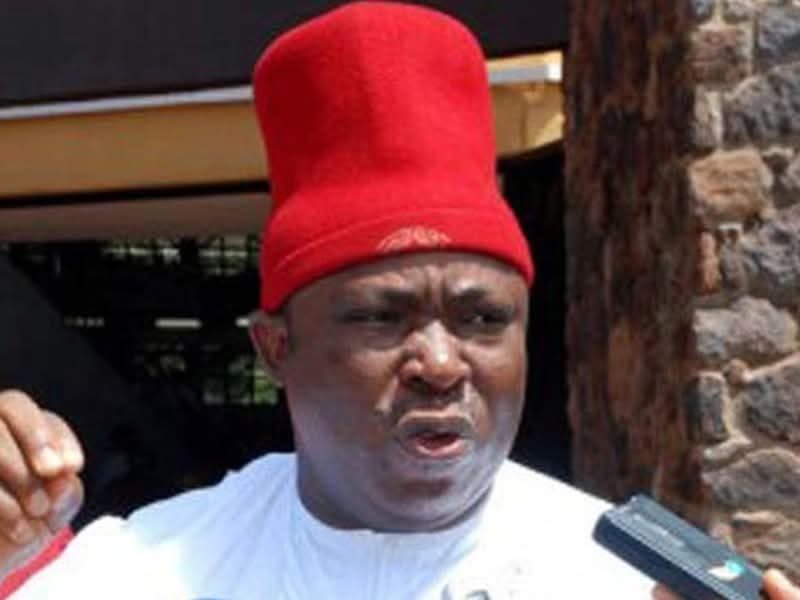
That is what Senator Victor Umeh did this week.
Leading a motion on the devastation in Anambra Central — specifically Ogidi, Obosi, Oko and surrounding communities — Umeh laid out the human cost in plain terms: at least four lives lost, including a pregnant woman and a six-year-old child; families displaced; homes and farmlands swallowed by expanding gully erosion; critical stretches of the Onitsha-Owerri Expressway and other federal roads under threat.
He was not the first lawmaker to raise the issue. He was, however, among the most insistent that the response could no longer be the familiar cycle of sympathy, a committee referral, and eventual silence once the rains ease.
The Senate’s reaction was telling. It directed NEMA to provide immediate relief materials. It tasked the Ministries of Works and Environment with rapid assessments, restoration of access routes, and long-term ecological control measures.
It mandated joint inspections by relevant committees with a report due within thirty days. A minute of silence was observed.
In the Nigerian legislative lexicon, these are the markers of urgency — the closest the upper chamber comes to declaring that a problem has moved from “noted” to “must be acted upon.”
This is representation in its most basic and least glamorous form. It is not ribbon-cutting. It is not the distribution of transformers or the announcement of constituency projects, important as those may be. It is the deliberate elevation of a prevalent local crisis — one that destroys livelihoods, claims lives, and undermines economic arteries — onto the federal agenda, with the demand that the centre stop treating it as a seasonal inconvenience to be managed by state governments and community self-help.
For years, gully erosion and flooding in Anambra and neighbouring states have been documented with grim regularity.
Communities lose streets, markets, and ancestral land. Federal roads become impassable. Yet the institutional response has often remained sluggish until the body count or the economic disruption becomes impossible to ignore.
Umeh’s motion did not invent the problem; it refused to allow the federal government to continue in its habitual state of delayed reaction.
By framing the crisis in concrete terms — lives lost, infrastructure threatened, families displaced — and by securing the co-sponsorship of colleagues from Ebonyi and Imo, he made the case that this was not an Anambra-only affair but a regional emergency with national implications.
Critics will note, correctly, that a Senate resolution is not the same as trucks of relief materials already on the ground or contractors mobilised to stabilise collapsing gullies.
The real test begins now: whether the directives to NEMA and the ministries produce visible action within the stipulated window, or whether they join the long list of resolutions that die quietly after the cameras leave.
Still, the alternative — waiting for another rainy season to produce more casualties before anyone in Abuja pays sustained attention — is worse.
In a federation as large and uneven as Nigeria’s, effective representation requires more than voting along party lines or defending zonal interests in abstract debates about revenue allocation.
It requires identifying the issues that are actively destroying people’s lives and property right now, carrying those issues to the federal table, and insisting that the institutions designed to respond actually do so.
Senator Umeh’s intervention this week was a reminder of that duty.
Whether the federal government remains awake long enough to act will determine whether this motion was merely another entry in the Hansard or the beginning of a more serious national response to an ecological crisis that has already claimed too many lives.
Whether the Senate’s directives translate into trucks of relief and engineers on the ground, or simply join the archive of well-intentioned resolutions, will soon become clear. What is already evident is that effective representation still means refusing to let a local disaster remain a local problem.
By placing the human and economic cost of Anambra Central’s ecological crisis squarely on the federal table and extracting a concrete timeline for action, Senator Victor Umeh performed the essential duty of his office. The rains will return; the question is whether Abuja will still be awake when they do.
-Pamela O.
Daily Buzzwire
About the Author