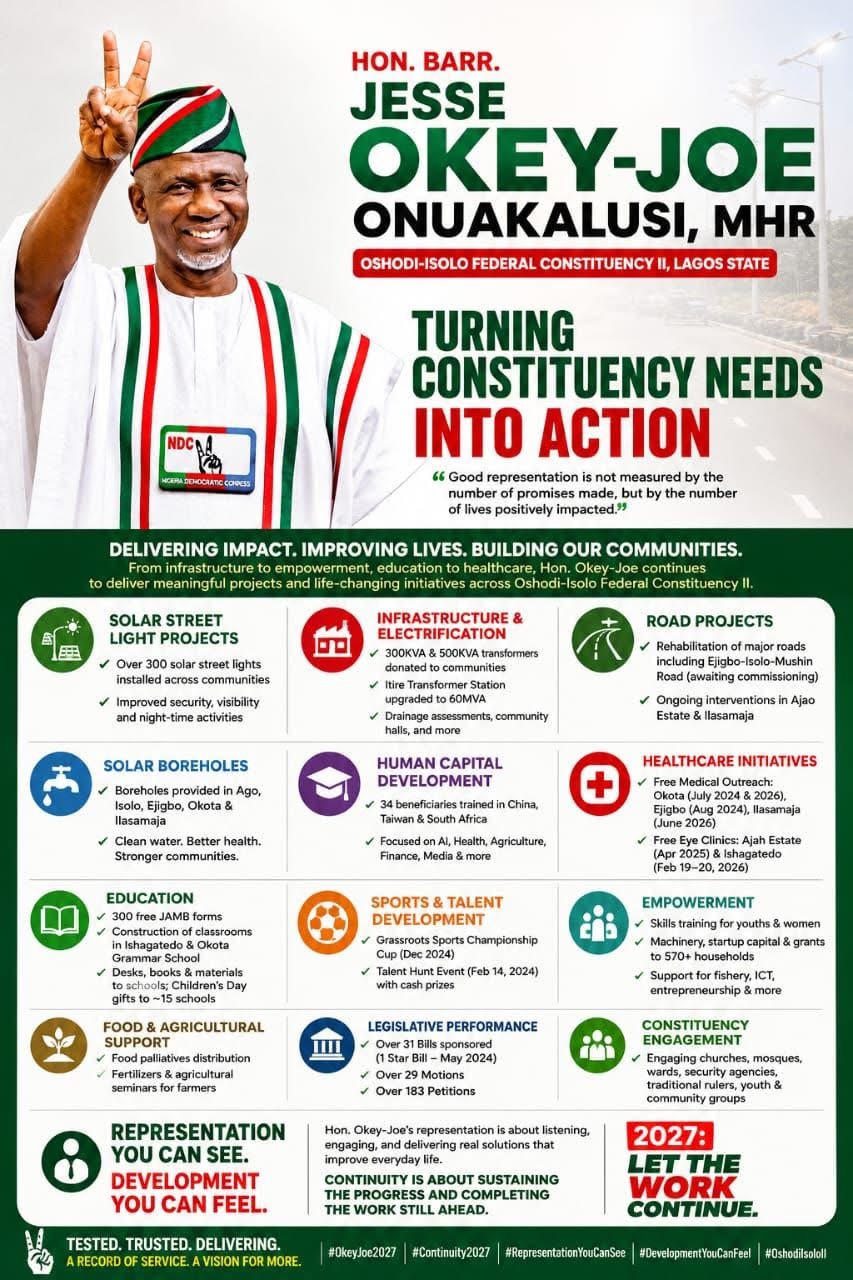
When news of Hon. Jesse Okey-Joe Onuakalusi’s bill to establish a Federal Vocational and Entrepreneurship Institute in Okota reached me, my immediate reaction was simple: this is the kind of practical, forward-looking legislation Nigeria needs more of.
Sponsored as HB.226 by the member representing Oshodi-Isolo Federal Constituency II in Lagos, the bill has already passed the House of Representatives and is now before the Senate.
In a country where formal university education remains out of reach for many, and where even degree holders often struggle to translate certificates into livelihoods, this proposal stands out as genuinely solution-oriented and sustainable.
Okota sits in one of Lagos’s busiest commercial and industrial corridors, home to artisans, mechanics, fabricators, traders, tailors and small business owners who already power local economic activity.
Rather than another generic institution, the bill envisions a federal facility specifically designed to deliver practical learning, on-the-job training, apprenticeships and courses leading to diplomas and certificates in vocational and entrepreneurial skills adapted to modern commercial and industrial needs.
Its functions, as outlined in the bill, include designing programmes for practical skills and accreditation of training units, offering certification that emphasises employability and self-employment, collaborating with agencies such as SMEDAN and NITDA to support small and medium enterprises and technology-based ventures, and conducting research that links training to real economic needs.
This is not abstract policy; it is an attempt to institutionalise pathways that turn existing talent and informal skills into certified, scalable economic value.
For young school leavers who never secured university admission, this institute would offer a dignified alternative route to a successful future.
For artisans already practising trades without formal recognition, it could provide structure, upgrading and certification.
For women and other young people with latent skills, it creates a platform to convert those abilities into businesses and income.
Onuakalusi has already demonstrated this orientation through constituency-level empowerment programmes that combine training with start-up support for women and youths; the institute would scale that philosophy into a lasting federal institution.
Nigeria’s labour market faces a well-documented skills mismatch. Universities continue to produce large numbers of graduates in fields with limited absorption, while shortages persist in practical technical, manufacturing, logistics and enterprise-related competencies.
Official unemployment rates have declined under recent measurement methods, yet underemployment, informal work and the absence of sustainable livelihood options remain widespread.
Teeming numbers of young people without productive engagement contribute to social pressures in urban areas.
An institute focused on vocational competence, entrepreneurship and adaptive technical skills directly addresses this by equipping people for employment, self-employment and the creation of further jobs—shifting some from job-seekers toward job-creators.
What makes the bill particularly commendable is its emphasis on sustainability.
It is not a one-off handout or short-term training scheme. It seeks to establish a permanent institution with a governing council, clear functions tied to national development needs, and mechanisms for collaboration with existing agencies.
Locating it in Okota brings a federal skills infrastructure closer to a dense population of potential beneficiaries rather than leaving such opportunities concentrated elsewhere.
Legislators across the country would do well to study this approach. Too many bills pursue symbolic or duplicative ends.
Prioritising constituency-relevant, skills-focused institutions that tackle unemployment at its roots represents a more productive use of legislative energy.
Thinking in this direction—creating durable platforms for economic self-reliance rather than temporary palliatives—is precisely the out-of-the-box orientation required for Nigeria’s prevailing challenges.
Hon. Onuakalusi’s initiative deserves support through the remaining legislative stages. If realised, the Federal Vocational and Entrepreneurship Institute in Okota would stand as a concrete example of representation that looks beyond immediate politics toward the long-term economic empowerment of ordinary citizens.
-Pamela O.
Daily Buzzwire
About the Author