
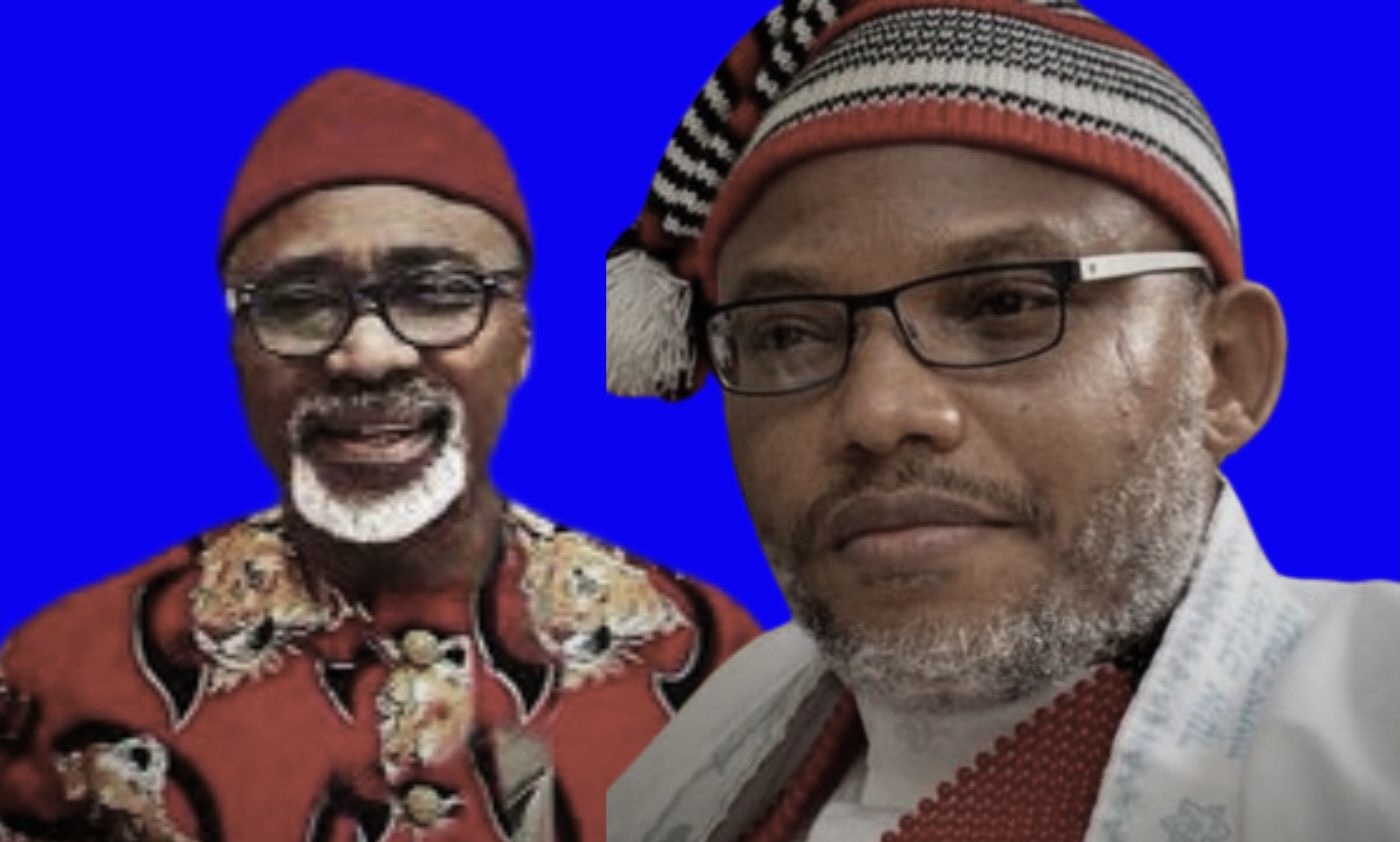
In the sweltering heat of an Abuja courtroom on April 25, 2017, Senator Enyinnaya Abaribe stepped forward with a pen in hand and a nation’s fractured hopes on his shoulders.
As the representative of Abia South, he affixed his signature to the bail bond for Nnamdi Kanu, the fiery leader of the Indigenous People of Biafra (IPOB), whose arrest had ignited a powder keg of ethnic tensions in Nigeria’s Southeast.
The bond? A staggering N100 million—pocket change for a senator, perhaps, but a profound gamble on justice, reconciliation, and the rule of law.
Joined by other prominent sureties, including a Jewish high priest and a former Abia governor, Abaribe’s act was framed as a bridge-building gesture from the Southeast Senate caucus, a collective plea for dialogue over division.
Little did he know, this signature would chain him to a decade-long odyssey of personal peril, public scorn, and unyielding advocacy—a testament to the exquisite, often excruciating price of principle.
The Bold Stroke: Signing for Solidarity
Abaribe’s decision was no impulsive flourish. Kanu, charged with treasonable felony for his separatist broadcasts, had been detained since October 2015, his case a lightning rod for Igbo grievances over marginalization.
Bail conditions were draconian: a senator as surety, alongside community leaders and a N300 million collective bond.
Abaribe, a veteran lawmaker with a reputation for intellectual rigor and regional loyalty, saw it as a moral imperative. “I came here to sign the bail bond for Nnamdi Kanu,” he declared outside the court, underscoring the condition that a sitting senator vouch for the IPOB leader’s appearance.
It was a calculated risk, rooted in the Igbo ethos of *ogbonge*—resolute communal defense—and a broader faith in judicial redemption.
For the Southeast, Kanu’s release symbolized more than one man’s freedom; it was a reprieve from the suffocating grip of federal overreach.
Abaribe, drawing from his own brushes with dissent (he’d once been detained under military rule), positioned himself as a mediator.
In interviews, he framed the suretyship as a humanitarian act, not an endorsement of secession: “This is about allowing voices to be heard without fear.
Yet, even then, whispers of peril circulated. Critics warned that vouching for a figure as polarizing as Kanu could tarnish a political career built on measured reform. Abaribe pressed on, his conscience unyielding, binding himself not just to a bond but to the volatile currents of Biafran aspiration.
The Fracture: Jumped Bail and the Weight of Betrayal
Freedom for Kanu lasted mere months. On September 14, 2017, amid escalating military raids on IPOB gatherings—including a deadly assault on Kanu’s Afara Ukwu home—he vanished. Israel, where he’d sought refuge, denied him asylum.
The sureties were summoned: produce Kanu or forfeit the bonds. Justice Binta Nyako, presiding over the Federal High Court, issued a stark ultimatum: “The sureties’ failure to produce Kanu would compel the court to invoke the forfeiture of their N100 million bail bond each.”
Abaribe, thrust into the crosshairs, applied urgently to be discharged from the suretyship, citing the impossibility of compliance and seeking a refund of his stake.
But the court was unrelenting. In November 2018, it ordered him to pay the full N100 million, a penalty that analysts later debated as disproportionate—why punish sureties for a defendant’s flight when the state holds the levers of enforcement?
Abaribe complied, remitting the sum from his personal resources, but the financial sting paled against the reputational hemorrhage.
Public vilification was swift and savage. Labeled a “betrayer” by some IPOB hardliners for his initial suretyship—ironic, given Kanu’s flight—while northern colleagues in the Senate mocked him as naive or complicit.
Then-President Muhammadu Buhari’s administration eyed him suspiciously; rumors swirled of arrest plots post the Afara Ukwu raid, where over 28 were killed.
Abaribe’s conscience, once a compass, now felt like chains—binding him to a cause that had turned on him, yet refusing to let him retreat. “Kanu’s bail put us in trouble,” he admitted in a 2017 reflection, but trouble, it seemed, was the forge of his resolve.
Forged in Fire: The Enduring Chains of Conscience
If 2017 marked the signing of the bond, the years since have etched it into Abaribe’s very sinews. Far from silencing him, the forfeiture amplified his voice.
By 2018, he was petitioning for discharge amid SSS detentions, a minor victory when the court ordered the FG to respond to his motion.
Kanu’s extraordinary rendition from Kenya in 2021—deemed illegal by courts—reignited Abaribe’s crusade.
He decried it as “state banditry,” vowing in Senate chambers that proceedings would halt until justice prevailed.
Fast-forward to October 2025, and those chains clank louder amid Kanu’s deteriorating health. Fresh from a court appearance where the IPOB leader appeared “very ill,” Abaribe has redoubled pleas to President Bola Tinubu for a humanitarian release.
Echoing Sowore’s #FreeNnamdiKanuNow mobilization, he frames detention as a “shield for tyranny,” drawing parallels to the June 12 annulment that claimed MKO Abiola’s life.
Suspended from APGA and navigating a Senate tilting toward APC dominance, Abaribe’s advocacy persists—vilified anew on X as a “clown” by detractors, yet hailed by supporters as the Southeast’s lone bulwark.
This is the paradox of conscience: it demands payment in full, yet yields no dividends save integrity. Abaribe’s N100 million was more than money; it was the toll for standing when others demurred, for believing in a Nigeria where dissent isn’t a death sentence.
As one X observer noted, “Abaribe stood for his bail… vilified, abused... but failed [the raid]. Today, you call them cowards?”
The chains bind, but they also brace—against the erosion of principle in a polity prone to expediency.
Legacy in Ink: A Cautionary Hymn
Senator Abaribe’s story is no hagiography; it’s a hymn to the hazards of moral audacity. In a nation where politicians pivot with the winds of power, his unswerving path—from bail bond to Senate barricades—illuminates the cost of conviction.
The price? Financial ruin, social exile, and the perpetual tug of “what if” Kanu hadn’t fled. Yet, in chaining himself to conscience, Abaribe has unshackled a conversation: on extrajudicial abductions, ethnic inequities, and the fragility of bail as a bulwark against tyranny.
As of this October 2025 dispatch, with protests brewing and Tinubu’s administration under scrutiny, Abaribe’s plea endures: release Kanu, not for politics, but for peace.
His bail bond, once a line on paper, now a ledger of loss and luminosity. In the end, principle’s price isn’t paid in naira alone—it’s tallied in the quiet forge of the soul, where chains of conscience either crush or crown. For Abaribe, they have done the latter, a senator forged unbreakable, reminding us that true freedom begins with one defiant signature.
Pamela O. writes from Lagos.
About the Author


