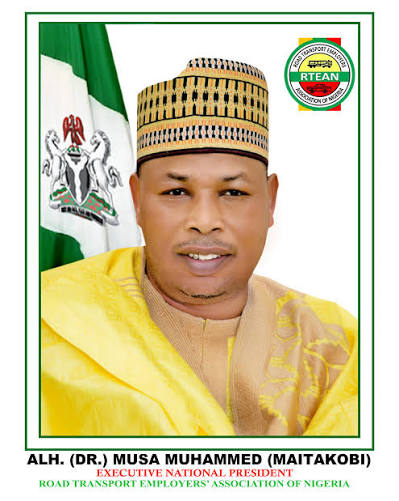
As of October 2025, the Road Transport Employers Association of Nigeria (RTEAN) is led by its Executive National President, Alhaji (Dr.) Musa Mohammed, fondly known as Maitakobi 1.
A seasoned transport magnate with decades of experience in the sector, Mohammed ascended to the presidency in 2021 amid fierce intra-union contests, only to solidify his position through a landmark Court of Appeal ruling in July 2025 that dismissed challenges from rival factions.
This judicial victory not only quashed attempts to oust him but also underscored his commitment to constitutional governance, setting a tone of resilience for the union he now helms from its Abuja headquarters.
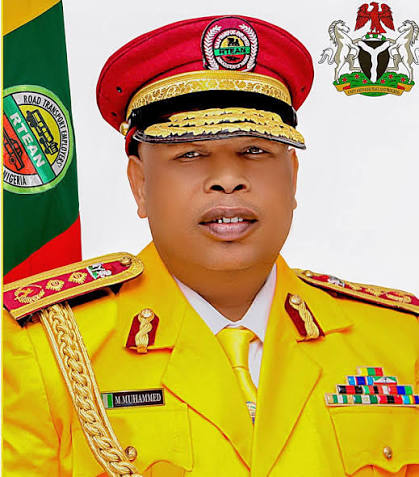
Under his watch, RTEAN—representing over 500,000 vehicle owners and operators nationwide—has pivoted toward modernization and accountability, distinguishing itself from peers like the National Union of Road Transport Workers (NURTW) through a laser focus on employer-centric reforms and strategic collaborations.
Mohammed’s Leadership: A Blend of Tenacity and Vision
Alhaji Musa Mohammed, a northern Nigerian transport baron based in Kano, brings a pragmatic edge to RTEAN’s helm.
His portfolio includes owning fleets that span inter-state routes, and he’s long advocated for policies easing operational burdens on business owners, from fuel subsidies to park management.
Unlike the often fractious leadership in other unions, Mohammed’s style emphasizes consensus-building; post his court affirmation, he swiftly convened National Executive Council (NEC) meetings to unify branches, averting the kind of prolonged stalemates that plague rivals.
His deputy, Ambassador Muhammad Abubakar Bishara, complements this with administrative savvy, handling day-to-day diplomacy with state governments.
Mohammed’s public persona—marked by high-profile delegations to governors and federal ministers—projects RTEAN as a professional lobby, not just a toll-collecting entity.
Key Changes Reshaping RTEAN in 2025
This year has been transformative for RTEAN under Mohammed, with changes that prioritize internal hygiene and external partnerships, fostering a more streamlined organization.
The most seismic shift occurred on September 29, 2025, when the NEC, chaired by Mohammed, dismissed National Secretary General Yusuf Ibrahim Adeniyi over allegations of misconduct and financial impropriety—stemming from an August suspension.
In his place, Comrade Henry Ejiofor Ugwu was appointed with immediate effect, a move ratified in an Abuja communiqué co-signed by Mohammed himself.
This swift, transparent transition—absent the leaks or litigation that often mar such purges—signals a zero-tolerance for graft, contrasting sharply with NURTW’s history of suspended executives lingering in limbo.
Beyond personnel, Mohammed has accelerated RTEAN’s embrace of the Presidential Compressed Natural Gas (CNG) Initiative, securing subsidized conversions for member vehicles since mid-October 2025.
This positions RTEAN as a forward-leaning player in Nigeria’s energy transition, with Mohammed personally lobbying for union-exclusive quotas at conversion centers.
Additionally, in response to commuter outcry over “agbero” (union-enforced) levies, RTEAN under his leadership issued guidelines in early October for ethical revenue collection, including digital ticketing pilots in Lagos and Ogun states.
These reforms, including a push for anti-extortion task forces with local governments, aim to rehabilitate RTEAN’s image amid state bans like Edo’s August 2025 prohibition on union activities.
No major disruptions have followed, thanks to Mohammed’s proactive truces with regulators.
What Sets RTEAN Apart: Employer Empowerment in a Worker-Dominated Field
While Nigerian transport unions like NURTW (focused on drivers’ welfare and labor rights) and others such as the Association of National Network of Employment and Water Transport (ANNEWAT) grapple with worker grievances and turf wars, RTEAN’s employer mandate carves a unique niche.
Established in 1978 as a counterbalance to NURTW’s 1978 formation, RTEAN exclusively champions vehicle owners and fleet operators, negotiating bulk deals on insurance, maintenance, and infrastructure that NURTW—representing individual drivers—cannot match.
This duality fosters occasional synergies, like shared park operations via 1980s agreements, but also rivalries, as seen in 2021 Obalende clashes or Kwara’s 2025 court affirmation of joint tricycle control.
Mohammed’s changes amplify these distinctions: RTEAN’s rapid leadership refresh and CNG prioritization reflect a business-oriented agility, enabling faster adaptation to economic shocks like fuel price hikes—unlike NURTW’s slower, protest-prone responses.
Where NURTW faces scrutiny for driver-led extortion, RTEAN’s reforms emphasize owner accountability, potentially reducing inter-union friction and attracting private investments (e.g., $1 billion in CNG infrastructure).
In essence, under Mohammed, RTEAN evolves from a reactive employer bloc to a proactive industry architect, modeling sustainable transport governance that could inspire—or pressure—its counterparts to modernize.
As Nigeria’s roads pulse with 47th-anniversary celebrations echoing RTEAN’s founding ethos, Alhaji Musa Mohammed’s tenure promises enduring impact: a union not just surviving rivalries, but redefining them through disciplined innovation.
Pamela O. writes from Lagos.
About the Author