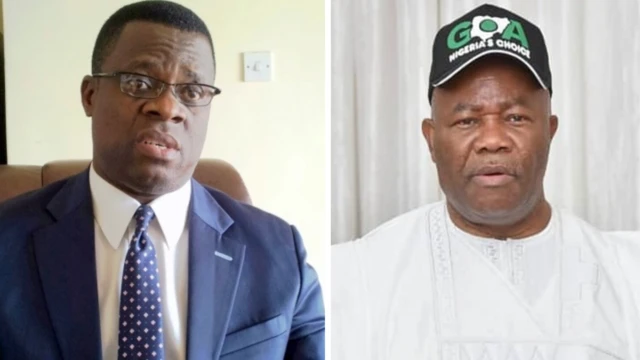
The recent Abuja (FCT) Area Council chairmanship and councillorship elections held on February 21, 2026, have unfolded amid significant scrutiny and are widely viewed as a microcosm—or “mirror”—of the potential challenges awaiting the 2027 general elections in Nigeria.
Key Events in the FCT Elections
The polls, covering six area councils including the high-profile Abuja Municipal Area Council (AMAC), proceeded with voting, but faced immediate concerns over transparency.
INEC clarified shortly before (and during) the process that results would not be transmitted in real-time to the IReV portal. Instead, uploads began gradually after the election, with some results trickling in over the following day.
This delay echoed criticisms from observers, civil society groups, and opposition voices who pointed to incidents like missing ballot papers (e.g., in Abaji, halting voting at certain units), voter apathy, intimidation claims, and logistical issues.
The absence of immediate, public real-time transmission fueled suspicions of irregularities, with social media and reports highlighting fears that manual handling could enable manipulation—especially in a capital territory seen as a test bed for national credibility.
Many Nigerians interpreted this as INEC prioritizing practicality over full transparency, particularly given the recent Electoral Act amendments.
Link to National Assembly’s Actions Under Akpabio
This FCT scenario directly reflects the contentious Electoral Act (Repeal and Re-enactment) Amendment Bill 2026, passed by the National Assembly (led by Senate President Godswill Akpabio) and signed into law by President Bola Tinubu just days earlier.
– The debate centered on electronic transmission of results from polling units to IReV.
– Initial versions saw the Senate (under Akpabio) reject or dilute mandatory real-time electronic transmission, citing risks like network failures, insecurity, or technical glitches that could invalidate results in affected areas.
– After public protests (including at the National Assembly, involving figures like Peter Obi), civil society outcry, and some reversals, the final law mandates electronic transmission but includes a
The recent Abuja (FCT) Area Council chairmanship and councillorship elections held on February 21, 2026, have unfolded amid significant scrutiny and are widely viewed as a microcosm—or “mirror”—of the potential challenges awaiting the 2027 general elections in Nigeria.
Key Events in the FCT Elections
The polls, covering six area councils including the high-profile Abuja Municipal Area Council (AMAC), proceeded with voting, but faced immediate concerns over transparency.
INEC clarified shortly before (and during) the process that results would not be transmitted in real-time to the IReV portal. Instead, uploads began gradually after the election, with some results trickling in over the following day.
This delay echoed criticisms from observers, civil society groups, and opposition voices who pointed to incidents like missing ballot papers (e.g., in Abaji, halting voting at certain units), voter apathy, intimidation claims, and logistical issues.
The absence of immediate, public real-time transmission fueled suspicions of irregularities, with social media and reports highlighting fears that manual handling could enable manipulation—especially in a capital territory seen as a test bed for national credibility.
Many Nigerians interpreted this as INEC prioritizing practicality over full transparency, particularly given the recent Electoral Act amendments.
Link to National Assembly’s Actions Under Akpabio
This FCT scenario directly reflects the contentious Electoral Act (Repeal and Re-enactment) Amendment Bill 2026, passed by the National Assembly (led by Senate President Godswill Akpabio) and signed into law by President Bola Tinubu just days earlier.
– The debate centered on electronic transmission of results from polling units to IReV.
– Initial versions saw the Senate (under Akpabio) reject or dilute mandatory **real-time** electronic transmission, citing risks like network failures, insecurity, or technical glitches that could invalidate results in affected areas.
– After public protests (including at the National Assembly, involving figures like Peter Obi), civil society outcry, and some reversals, the final law mandates electronic transmission but includes a fallback provision: presiding officers can rely on manually signed Form EC8A for collation if connectivity fails, with uploads expected once networks recover.
– Akpabio repeatedly defended this as not rejecting e-transmission outright but making it pragmatic and inclusive of Nigeria’s realities (e.g., poor network coverage in some regions). Critics, however, argue this “manual backup” clause creates loopholes for altering results during physical movement or collation—reverting to pre-2023 vulnerabilities that sparked massive distrust.
The FCT’s non-real-time approach aligns precisely with this framework: even in well-connected Abuja, full immediate transmission was not enforced, raising questions about how rigorously INEC will apply the electronic mandate nationally in 2027.
Implications for 2027 and Opposition Candidates
Many analysts and opposition supporters see the FCT polls as a preview of how the 2027 presidential, National Assembly, and gubernatorial elections could unfold—potentially disadvantaging credible opposition candidates:
– Without guaranteed real-time public viewing of results, manipulation risks increase at collation centers (where manual processes dominate under the fallback). This could allow “writing” of results in favor of the ruling APC, as alleged in past cycles.
– Credible opposition figures (e.g., from PDP, Labour Party, or others) often rely on transparency tools like IReV to mobilize evidence for challenges or public pressure. Delays or selective uploads erode this, making it harder to prove discrepancies quickly and credibly.
– The pattern demoralizes voters and opposition supporters, as seen in post-FCT commentary: low turnout, youth apathy, and beliefs that the system is rigged against challengers. This could suppress turnout or fragment opposition efforts in 2027.
– If the FCT (a high-visibility, urban area) already shows transmission delays and controversies, critics fear worse in rural or insecure states—where network issues provide cover for alleged rigging.

Control any appliance with your phone
• Works with Alexa & Google Home
• Schedule on/off
• No hub required
Buy now → https://www.amazon.com/dp/B07K1H5BMK?tag=gadgets00139-20
In summary, the Abuja chairmanship elections’ handling—delayed/non-real-time transmission despite infrastructure advantages—serves as a stark reflection of the National Assembly’s (Akpabio-led) refusal to entrench mandatory, unbreakable real-time e-transmission.
This has amplified fears that 2027 will feature similar opacity, tilting the field toward incumbents and making it tougher for strong opposition candidates to emerge victorious or even mount effective post-election challenges.
Whether INEC enforces the electronic priority rigorously remains the critical unknown, but the FCT experience has left many viewing it as a warning sign rather than reassurance.
Pamela Ogwata, political columnist and strategist.

Lowest price this year
• A16 Bionic chip
• All-day battery
• Works with Apple Pencil
Buy now → https://www.amazon.com/dp/B0DKF2GLZP?tag=gadgets00139-20
About the Author