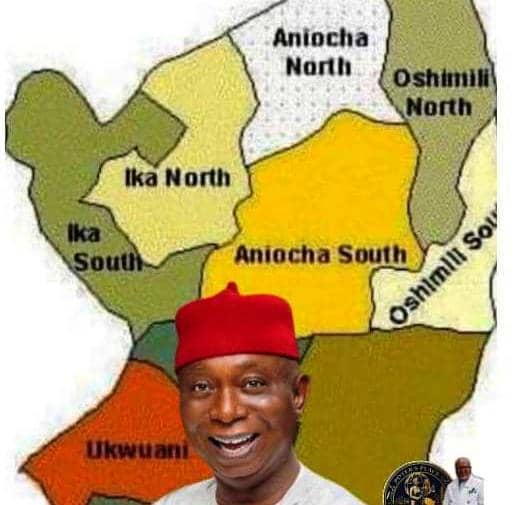
In the grand theatre of Nigerian federalism, where states are not mere administrative units but emblems of identity, justice, and belonging, the push for Anioma State stands as one of the most compelling unfinished chapters. For over 50 years, the people of Delta North — spanning the nine local government areas of Aniocha, Oshimili, Ika, and Ndokwa — have agitated for their own state.
The Dawn of Anioma: A Long-Awaited Triumph of Equity and Historical Justice.
What was once a whisper of cultural self-assertion has now become a structured national imperative, propelled into the fast lane by the visionary legislation and relentless lobbying of Senator Prince Ned Nwoko.
This is not a sudden political fancy. The agitation traces its roots back to the 1950s, with echoes in the pre-independence era and post-civil war realignments that left Anioma communities — bound by language, culture, and heritage to their Igbo kith and kin — administratively marooned in the Midwest, later Delta State.
Colonial boundaries and the fractures of nation-building artificially separated a people who share deep ancestral ties across the Niger.
For generations, Anioma sons and daughters have felt the sting of marginalisation: underdeveloped infrastructure relative to potential, diluted political influence, and an identity crisis that no amount of “Delta” branding could fully erase.
The demand for Anioma is, at its core, a historical necessity — a correction of imbalances that have lingered since the colonial scribes drew their maps.
Successive military and civilian dispensations heard the cries. Prominent Anioma leaders, traditional rulers, and intellectuals kept the flame alive through memoranda, conferences, and quiet advocacy.
Yet, for decades, it remained aspirational — bogged down by bureaucratic inertia, competing regional interests, and the sheer complexity of Nigeria’s state creation process. That changed dramatically with Senator Ned Nwoko’s intervention.
As the representative of Delta North in the 10th Senate, Nwoko did not merely inherit the agitation; he professionalised and accelerated it.
His bill — Senate Bill 481 — seeks to amend the 1999 Constitution (as amended) to carve out Anioma from Delta State, providing the constitutional, demographic, economic, and geographic justifications required. More than paperwork, Nwoko’s approach has been masterclass lobbying: personally engaging colleagues, securing endorsements from an unprecedented 85 to over 97 senators (well above the two-thirds threshold), and winning the backing of President Bola Tinubu and Senate President Godswill Akpabio.
What sets Nwoko apart is the structured momentum he injected. He presented verifiable data on population, economic viability (oil and gas, arable land, strategic location along the Niger), and cultural coherence.
Public hearings, including in Ikot-Ekpene, showcased overwhelming grassroots support from traditional rulers, youth, and professionals. The agitation evolved from an emotional quest into a credible, documented national process.
As Nwoko himself noted, this consummates the vision of legends who pioneered the movement since 1954.
Critics have raised voices — some Aniocha-Oshimili groups express concerns about geopolitical alignment with the South East, preferring Anioma remain distinctly itself.
These debates are healthy in a democracy; identity is nuanced, and Anioma’s rich tapestry deserves careful handling.
Yet the broader thrust toward equity remains compelling: creating Anioma as the sixth state in the South East would address the zone’s long-standing numerical disadvantage in the federation, enhance development, and affirm the principle that no group should be perpetually short-changed by historical accidents.
As a columnist who has watched Nigeria’s federal experiments, I see in this moment a rare convergence of history, politics, and justice.
Senator Ned Nwoko’s name is fast being inscribed in the annals not as a mere sponsor of a bill, but as the architect who turned decades of aspiration into imminent reality.
His lobbying has not been self-serving but a bridge across generations — ensuring that an Ndokwa son or daughter could one day govern a viable Anioma State with Asaba as a ready capital.
The road ahead involves state assemblies’ approvals and a referendum, but the trajectory is clear. Nigeria stands at a threshold where equity demands can no longer be deferred. Anioma’s realisation would not only fulfil a 70-year-old dream but strengthen the federation by recognising that true unity flows from fairness, not forced amalgamations.
History will remember the pioneers. And it is recording, in bold letters, the decisive chapter written by Ned Nwoko. The people of Anioma deserve their state. The time is now.
Pamela O. political columnist and commentator.

Best e-reader ever made
• Waterproof + warm light
• 10 weeks battery life
• 300 PPI glare-free screen
Buy now → https://www.amazon.com/dp/B0CFPJPG9W?tag=gadgets00139-20
As an Amazon Associate I earn from qualifying purchases.
About the Author