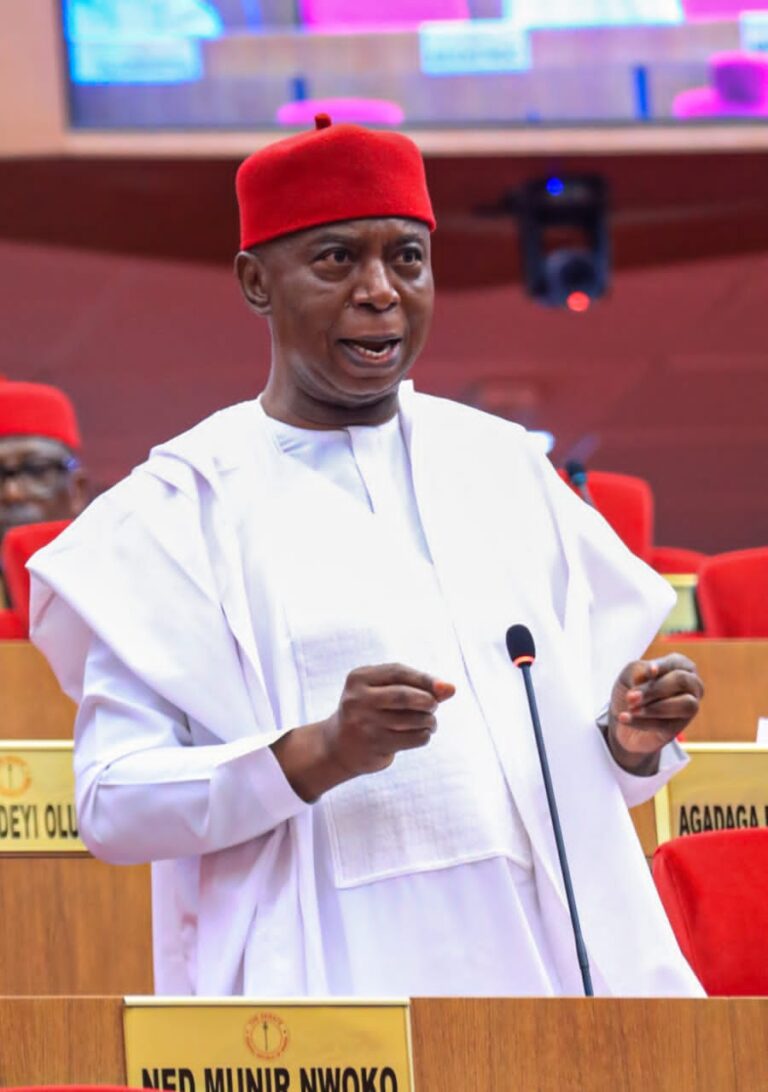
In the often cynical arena of Nigerian politics, where grandstanding frequently overshadows substance, Senator Ned Munir Nwoko has pulled off a quiet but profound legislative victory that deserves more than passing applause.
By successfully piloting a motion that compels the Independent National Electoral Commission (INEC) to restore Aniocha North Constituency II in Delta State, Nwoko has not only delivered long-overdue justice to thousands of citizens but has also reinforced a principle too often treated as optional: that judicial pronouncements must be obeyed.
The facts of the case are as startling as they are instructive. Created in 1991 and operational from 1992, the constituency—encompassing communities such as Idumuje Unor, Idumuje Ugboko, Aniofu, Nkwu Nzu, Ugboba, Ugbodu, Idumuogo, Ubulubu, Ogodor, and Anioma—was effectively wiped from the electoral map following the 1993 military coup.
When civilian rule returned in 1999, this anomaly was not corrected. For over three decades, these communities existed in a constitutional twilight zone: citizens paying taxes, obeying laws, and expecting governance, yet denied the fundamental right to direct legislative representation at the state level.
The people refused to accept this erasure. They waged a determined legal battle that culminated in favourable judgments from the Court of Appeal and, decisively, the Supreme Court of Nigeria in 2019.
Yet even the apex court’s verdict was met with bureaucratic inertia. This is where Senator Nwoko’s intervention became pivotal. Upon assuming office as the representative of Delta North Senatorial District, he took personal ownership of the matter.
His motion, titled “Restoration of Aniocha North II State Constituency Pursuant to Supreme Court Judgment,” was not mere rhetoric. It framed the issue as both a local injustice and a national threat to constitutionalism—highlighting other constituencies potentially trapped in similar limbo.
The Senate’s unanimous passage of the motion sent a clear signal. INEC has now responded by directing political parties to conduct primaries in the restored constituencies ahead of the 2027 general elections. After 32 years, the wait is effectively over.
What This “Stunt” Truly Entails
Beyond the headlines, Nwoko’s achievement carries several layers of significance:
A Victory for the Rule of Law
In a country where court judgments are sometimes treated as suggestions rather than commands, the enforcement of this Supreme Court ruling sets a healthy precedent.
It demonstrates that persistent, lawful advocacy—rather than violence or political patronage—can still bend the arc of governance toward justice. Nwoko’s approach strengthens democratic institutions by insisting that the legislature can and should act as a check against executive or bureaucratic foot-dragging.
Enhanced Representation and Political Realignment in Delta North
The restoration directly empowers the Idumuje and Odiani clans, giving them a dedicated voice in the Delta State House of Assembly.
This is not tokenism; it is structural inclusion. For communities that felt marginalised for a generation, the psychological and political impact is immense.
It also burnishes Nwoko’s credentials as a senator who delivers tangible results rather than just constituency projects or media visibility. In the run-up to future elections, this will be political capital of the highest order.
Broader National Resonance
The motion deliberately drew attention to similar affected constituencies across Nigeria. By framing Aniocha North II as a test case, Nwoko has opened the door for other long-forgotten electoral anomalies to be corrected.
This elevates the matter from parochial Delta politics to a conversation about the integrity of Nigeria’s federal structure and electoral architecture.
A Lesson in Political Craftsmanship
Calling this a “stunt” is not dismissive—it acknowledges the theatrical dexterity involved. Nwoko timed his intervention after assuming office, leveraged the moral authority of the Supreme Court, secured unanimous Senate buy-in, and maintained pressure until INEC acted.
In Nigeria’s National Assembly, where many motions die on the order paper, achieving this outcome reflects both strategic patience and effective caucusing.
As the affected communities celebrate, the real test now shifts to implementation. Political parties must conduct credible primaries, candidates must emerge who truly represent local aspirations, and the new constituency must translate restored representation into visible development.
Traditional rulers, community leaders, and the legal team that fought this battle for decades deserve immense credit; Nwoko has wisely positioned himself as the facilitator who finally broke the impasse.
In an era when public trust in politicians is perilously low, actions like this matter. Senator Ned Nwoko has reminded us that democracy’s strength lies not just in periodic elections, but in the relentless correction of its historical distortions.
After 32 years, justice has not merely been spoken—it has been delivered. That is no small feat in Nigerian politics.
Pamela O.
Political analyst and columnist

DOCUMENT: Nasarawa C of O
INSPECTION DAYS : every Wednesday and Saturday from 10am – 2pm
About the Author