By a Political Analyst and Columnist, Pamela O.
In Oyo State, the pattern since 1999 has been stubborn: governors rarely succeed in installing their preferred successors.
From the Ajimobi era’s near-miss with Adebayo Adelabu to earlier transitions that collapsed under the weight of ambition, ego and factional arithmetic, the Agodi Government House has resisted orderly handovers.
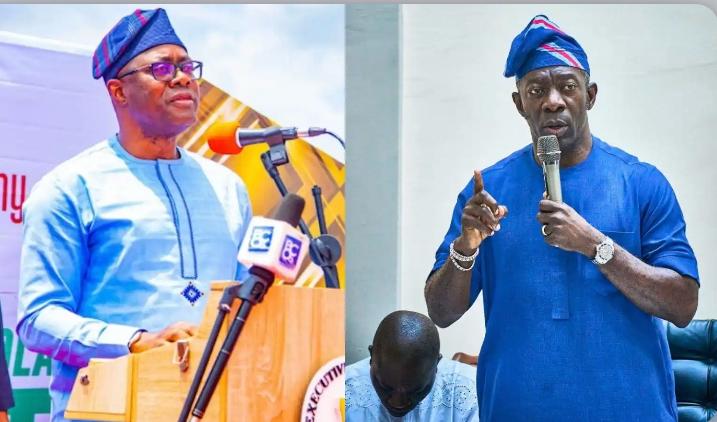
Governor Seyi Makinde is now testing that pattern with Bimbo (Abimbola) Adekanmbi, the Allied People’s Movement (APM) governorship candidate he has publicly anointed for 2027 as “Omituntun 3.0.”
The choice is deliberate and, in the governor’s own telling, rooted less in political loyalty than in professional competence.
Makinde has repeatedly framed the criteria as capacity, intellect, temperament and youthful energy rather than party colour or personal indebtedness.
He describes Adekanmbi as a first-class graduate, chartered accountant and fellow of his profession whose record demonstrates the ability to deliver.
The governor has drawn a parallel to his own path: success in the private sector before politics, not a career of pure politicking.
He has also noted the physical demands of the office—constant travel, project inspections, engagement across the state—and argued that Oyo should not become a “geriatric state.”
Adekanmbi’s résumé supplies the substance behind the rhetoric. An Ibadan indigene, he studied accounting at Obafemi Awolowo University, added applied accounting credentials from Oxford Brookes, earned an MBA, and became an FCCA.
He worked in Nigerian banking before consulting on major UK projects (including for IBM and Accenture clients). Under the late Abiola Ajimobi he served as Deputy Chief of Staff and then Commissioner for Finance, Budget and Planning (roughly 2016–2019), a period of national fiscal strain in which he helped stabilise state finances.
Makinde later appointed him to chair the technical committee on the upgrade of the Samuel Ladoke Akintola Airport in Ibadan—an assignment that required creative financing after federal approval arrived without full funding.
Makinde has cited that work as evidence of the man’s practical capacity. He even nominated Adekanmbi for a federal ministerial slot under President Tinubu (who ultimately chose Adelabu instead).
This profile gives Adekanmbi a clear edge over many of the names that circulated earlier inside Makinde’s PDP-aligned structure.
Those expected contenders were typically long-serving political operators—figures who had branded campaigns, organised structures, delivered zones such as Oke-Ogun, or managed youth and government machinery.
Their claim rested primarily on loyalty and contribution to the 2019 and 2023 victories. Adekanmbi, by contrast, brings cross-administration experience (Ajimobi’s APC government, then collaboration with Makinde), deep public-finance expertise, and a private-sector orientation that aligns with the governor’s infrastructure- and data-driven style.
He is not a pure product of the current political machine; he is a technocrat who has navigated multiple parties (APC, brief PDP involvement, then APM platform) while maintaining a reputation for competence over pure partisanship.
Makinde has been explicit that the successor must be loyal to Oyo State, not to him personally, and has publicly advised Adekanmbi not to inherit his enemies or political liabilities.
The downside is equally visible. The decision has already produced friction, defections and quiet disengagement among some of the governor’s core political foot soldiers who feel sidelined.
In Nigerian politics, inclusion often trumps pure logic; rewarding the technocrat while the organisers wait can fray the structure that delivered the mandate.
Adekanmbi has sought to distance himself from the “surrogate” label, insisting he has his own path and manifesto, yet the continuity branding (“Omituntun 3.0”) remains central to the project.
History in Oyo suggests that even a well-chosen successor can still face the electorate’s independent will, the opposition’s regrouping (APC is fielding Senator Sharafadeen Alli), and the inevitable claim that the outgoing governor is trying to extend his influence by other means.
Makinde’s bet is that competence, fiscal literacy and the ability to sustain ongoing projects will matter more to voters than pure political pedigree.
Whether that calculation holds through 2027 will depend less on the endorsement itself than on Adekanmbi’s ability to convert technocratic credentials into broad political ownership—and on whether the governor’s structure holds together long enough to deliver it.
In a state where succession has repeatedly defeated its architects, this remains an open experiment rather than a settled inheritance.
About the Author