Screenshot
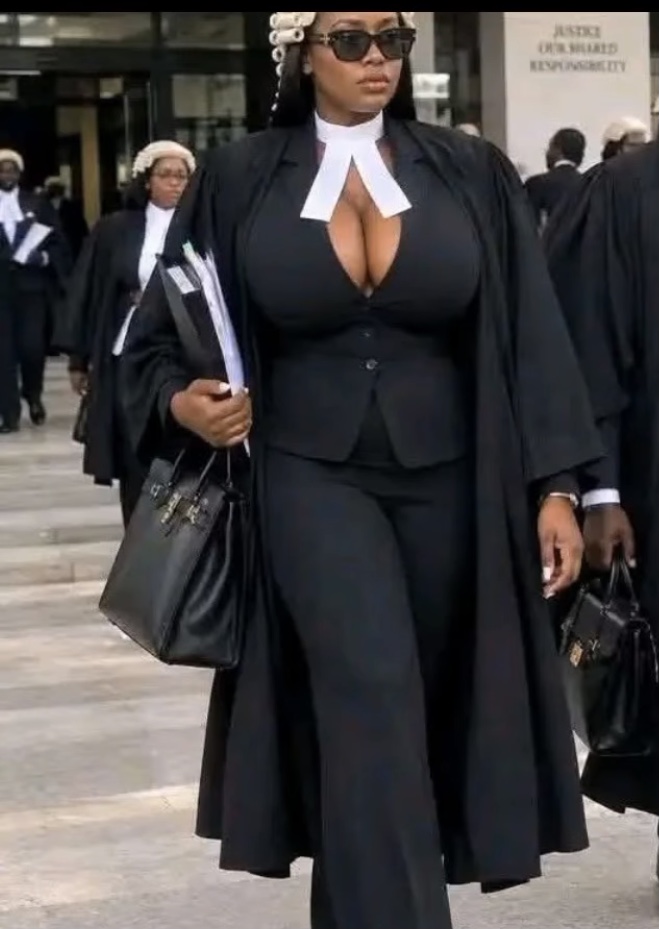
The photograph circulating of the woman identified in posts as Barr. Taiwo, taken outside the High Court of Lagos State in full wig, gown, bands and collar, shows a deeply cut neckline under the robes that prominently displays cleavage.
That choice conflicts with the professional standards the Nigerian Bar already has on the books.
Rule 36 of the Rules of Professional Conduct for Legal Practitioners 2023 requires that, when in the courtroom, a lawyer “be attired in a proper and dignified manner and shall not wear any apparel or ornament calculated to attract attention to himself.”
The same rule demands observance of the customs of the court and the Bar on dress and manners.
Parallel expectations appear in the Nigerian Law School code and in long-standing practice directions: white blouse or shirt, dark formal suit or skirt/trousers of proper length, bib and bands, gown and wig, with nothing calculated to draw the eye away from the argument.
Guides for female counsel repeatedly specify modest necklines, no flashy accessories, and clothing that does not compete with the regalia.
The low cut visible in the image is the opposite of that standard. It converts the uniform of an officer of the court into a personal display.
The wig and gown exist precisely to strip away individual style, status and sexuality so that counsel appear as interchangeable advocates for their clients and the court. Once the neckline is cut to advertise the body underneath, the regalia stops performing that function.
Online commentary that treats the result as “wahala,” jokes that opposing counsel will lose focus, or asks for her contact details simply confirms the distraction the rule forbids.
Court is not a film set in which a striking appearance is a tactical advantage; it is a place where the client’s case is supposed to be the only thing on display. Foreign movie tropes about seduction have no bearing on Nigerian practice.
The photograph was taken on the steps rather than inside the courtroom, but the person is already robed as counsel appearing at that court.
Professional dignity does not switch off at the door. Courts have long refused to hear advocates who are improperly dressed; the power sits with the judge and, ultimately, with the disciplinary machinery of the Bar.
The Nigerian Bar Association, the Body of Benchers and individual judges already possess the tools—Rule 36, practice directions, and the power to decline audience. Waiting for still more extreme examples before applying them is an enforcement failure, not a gap in the rules.
The same standard applies to male counsel: an open shirt, loud ornament or casual footwear under the gown is equally non-compliant. Selective silence does not make the rule gender-specific.
Personal dress outside professional duties is a private matter. Once the wig and gown are on, the lawyer is no longer merely expressing a lifestyle; she is representing the profession and the client before the public and the court. The image fails that test.
#TrendingReels #reelsviral #reelschallenge #contentcreator #read #lawyer
-Pamela O.
Daily Buzzwire
About the Author