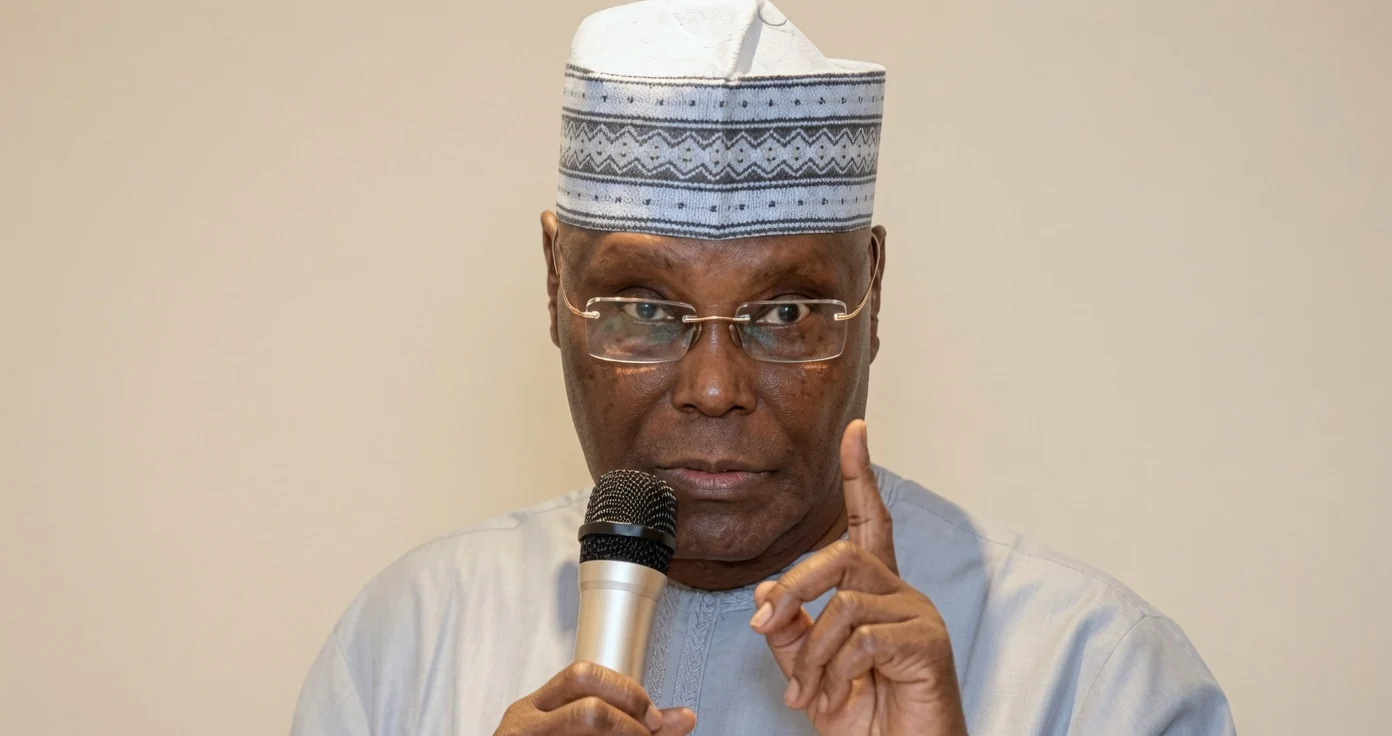
Atiku Abubakar’s 2027 bid from the North does carry a clear risk of fresh regional agitation, win or lose, precisely because the dominant informal understanding is that this remains the South’s turn until 2031.
Nigeria’s post-1999 practice has treated the presidency as rotating between North and South roughly every eight years, even though the 1999 Constitution contains no such rule. Muhammadu Buhari (North) completed two terms (2015–2023); Bola Tinubu (South-West) took office in 2023.
The prevailing elite and regional consensus—voiced by Southern and Middle Belt Leaders Forum, Ohanaeze, Afenifere elements, PANDEF, and even some Northern figures—is that the South should finish an eight-year cycle before power returns North in 2031.
Atiku, the African Democratic Congress candidate and a North-East (Adamawa) politician, has rejected that framing and called 2027 his final attempt.
His arithmetic is the Fourth Republic only: by 2027 the South will have held the presidency for roughly 18 years (Obasanjo 8, Jonathan’s completion of Yar’Adua’s term plus his own, Tinubu’s first term) against about 10–11 for the North (Yar’Adua’s partial term plus Buhari’s eight).
He treats zoning as a party convention rather than a binding national compact, notes that only the PDP has written it into its constitution, and says he would push a constitutional amendment to entrench rotation—including across the six zones—if elected.
His camp also argues strategy: no incumbent has been defeated by an opposition candidate from the same broad geopolitical bloc, so a Southern opposition ticket against Tinubu is self-defeating.
That calculation collides with the stability argument. Former Kaduna senator Shehu Sani, himself a Northerner, has stated publicly that an Atiku victory would effectively end the rotational arrangement and produce “hard and bitter feelings” across the South-West, South-East and South-South, leaving any new president to manage a country full of animosity.
He has also warned that a Northern attempt to reclaim the office in 2027 risks reigniting separatist agitation that has receded partly because Southern candidates (including Peter Obi) remain in the race and the South still sees a path to completing its cycle.
Southern and Middle Belt leaders have issued similar communiqués insisting the presidency stay South after 2027 “in the interest of national political stability.”
Northern voices such as Kano Governor Abba Yusuf and former Borno governor Ali Modu Sheriff have told Northern aspirants to wait until 2031. The PDP has already zoned its 2027 ticket South.
The risk does not require Atiku to win. A serious Northern bid itself reopens the 2023 grievance (when Atiku took the PDP ticket against the zoning sentiment that produced the G5 revolt) and supplies a ready narrative for groups that already treat power rotation as the minimum price of staying inside the federation.
Failure can still leave residual mobilisation, boycott talk, or post-election protests framed as “Northern truncation of the Southern turn.”
Success would, on Sani’s reading and that of the regional forums, collapse the informal stabiliser and raise the temperature of existing fault lines—IPOB-linked sentiment in the South-East, Yoruba self-determination currents in the South-West, and resource-control agitation in the South-South—regardless of Atiku’s personal record or policy platform.
Counter-pressures exist. Economic hardship and insecurity give any opposition candidate, Northern or Southern, a performance argument that can cut across zone.
Atiku’s long coalition-building history and the ADC’s attempt to assemble a national platform are real assets inside the North and parts of the Middle Belt.
Constitutional eligibility is undisputed. But in a federation whose parties and regional blocs have repeatedly used zoning to dampen zero-sum ethnic competition, treating 2027 as open season for a Northern return tests the convention that has so far substituted for a formal power-sharing clause.
The agitation risk is therefore structural, not contingent on the final result.
Atiku’s insistence on running in 2027 does not merely test the Southern turn; it multiplies the field in a way that can structurally favour a Northern recovery of the office, while a victory would convert that arithmetic into fresh agitation.
Because he has refused to defer, the opposition is no longer a single Southern challenge to a Southern incumbent.
Peter Obi, Seyi Makinde and other zonal aspirants are already in or positioning, alongside Tinubu’s re-election bid.
A crowded ballot splits the Southern and anti-incumbent vote across parties and zones, while Atiku concentrates the core Northern bloc that he still assumes he is the most viable national contender.
His own camp has made the strategic claim explicit: no Southern opposition candidate has ever unseated a sitting Southern president, so zoning the challenge South hands the incumbent a clearer path.
Multiple Southern and Middle Belt contenders therefore dilute the very regional solidarity that the “Southern turn” argument requires, leaving the North comparatively unified behind one heavyweight.
Even a narrow loss leaves that organisational advantage intact for 2031; a win converts it into power.
If he wins, the animosity Shehu Sani and the Southern and Middle Belt Leaders Forum have already flagged becomes operational. An Atiku presidency in 2027 would be read across the South-West, South-East and South-South as the abrupt end of the informal eight-year rotation that followed Buhari, not as a routine alternation.
That reading supplies the grievance for newest agitations—renewed separatist mobilisation where hope of a Southern completion had quieted it, resource-control and self-determination rhetoric framed as resistance to truncation, and post-election protests treated as defence of equity rather than ordinary opposition.
The constitution permits the bid; the political settlement that has managed Nigeria’s regional competition does not price it as costless.
Insistence therefore advantages the North in a fragmented race, and success risks reopening the agitations the rotation convention was designed to contain.
-Daily Buzzwire
About the Author