

By Minnie James.
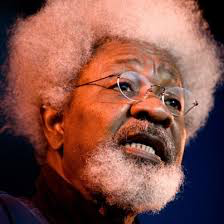
It’s a strange time to be Nigerian. The air is thick with the smoke of unrest—economic collapse, rampant insecurity, and a government that seems more adept at spinning promises than delivering solutions. Inflation gallops unchecked, bandits roam with impunity, and the average citizen’s hope flickers like a candle in a storm. Nigeria, by any measure, is a nation ablaze. Yet, in this moment of profound domestic chaos, one of our most celebrated voices, Nobel Laureate Wole Soyinka, has turned his gaze outward. “I am saddened by happenings in America,” he declares, as if the fires scorching his homeland are mere embers compared to the distant glow of a far-off superpower.
This is not the Soyinka many of us grew up admiring—the fearless playwright who once stared down tyrants, who penned *The Man Died* from the depths of a prison cell, who wielded words like weapons against injustice. That Soyinka was a moral compass, a man whose integrity seemed unassailable, whose voice thundered when Nigeria’s soul was at stake. But today, as the country he helped define staggers under the weight of misrule, his silence on our plight is deafening. Instead, he mourns the state of America—a nation that, for all its flaws, boasts a functioning democracy, a robust economy, and a level of stability Nigerians can only dream of. The irony is as bitter as it is bewildering.
What is it about America that so captivates Soyinka’s sorrow? Is it Donald Trump’s return to power, a figure he once reviled enough to shred his green card over? Is it the policies of a man whose influence, however polarizing, operates within a system that still affords its citizens rights and recourse? Compare that to Nigeria, where dissent is met with batons or bullets, where elections are a theater of fraud, and where the common man’s cry for justice is drowned out by the clinking of looted coins. America’s troubles, real as they may be, pale beside the visceral, daily torment of life in Nigeria. Yet Soyinka, perched in his intellectual tower, seems more attuned to the dramas of “MAGA land” than the tragedies unfolding in his own backyard.
This is not to say Soyinka has no right to comment on global affairs. His stature as a literary giant and a humanist grants him that latitude. But when a man of his influence chooses to lament a foreign nation’s woes while Nigeria burns, it raises questions—of relevance, of priorities, of integrity. In 2016, Soyinka’s symbolic tearing of his U.S. green card was a dramatic protest against Trump’s election, a gesture that resonated with his history of bold stands. Yet, since then, his critiques of Nigeria’s own leadership have softened, replaced by a curious reticence. Where is the fire that once fueled his condemnation of military dictators? Where is the outrage at a government that has turned a resource-rich nation into a beggar state?
Some might argue that Soyinka, at 90, has earned the right to focus on whatever moves him. Perhaps he sees America’s struggles as a microcosm of global decline, a warning for us all. But that feels like a generous stretch. Nigeria’s chaos is not abstract—it’s the hunger in our bellies, the fear in our streets, the despair in our children’s eyes. To ignore that while shedding tears for a distant shore suggests a disconnect that borders on the surreal. It’s as if Soyinka has traded his role as Nigeria’s conscience for that of a detached observer, more comfortable critiquing a superpower than confronting the failures of his tribesman’s regime.
Integrity, after all, is not just about what you say—it’s about what you choose to see. Soyinka’s lament for America might be heartfelt, but it rings hollow when Nigeria’s cries go unanswered. A man of his intellect cannot be blind to the reality around him; he must simply have chosen to look away. And in that choice lies a tragedy far sadder than anything unfolding across the Atlantic. For if even our greatest minds can drift so far from home, what hope remains for the rest of us, left to choke on the ashes of a nation ignored?
—
This column critiques Soyinka’s focus on America over Nigeria, questioning his relevance and integrity in the context of Nigeria’s current crises, while acknowledging his past contributions. It’s written with a mix of disappointment, irony, and urgency, as a columnist might aim to provoke thought and stir debate.


