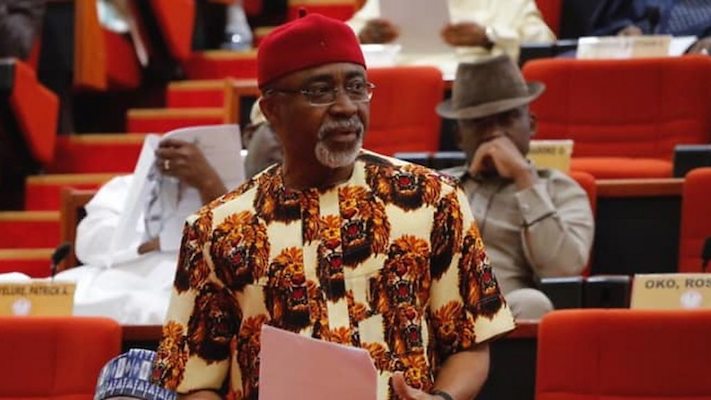
In the rough-and-tumble arena of Nigerian politics, where noise often drowns out substance and propaganda machines work overtime to rewrite realities, Senator Enyinnaya Harcourt Abaribe stands as a refreshing constant — a gentle, principled, and unapologetically Igbo-loving statesman whose record speaks louder than the orchestrated whispers of his detractors.
For nearly two decades, this son of Abia has represented the Abia South Senatorial District with a rare blend of vocal legislative courage and quiet developmental footprints.
Yet, as 2027 approaches, a chorus of opponents — some nursing personal ambitions, others riding partisan waves — peddle the tired narrative that “Abaribe has done nothing” or that “he has stayed too long.”
Let me state it plainly as a seasoned observer of the political landscape: that claim is not just misleading; it is a deliberate distortion that facts, visible projects, democratic principles, and comparative performance continue to shame into silence.
Senatorial seats are not banquet halls or dining tables — “go and eat” when it is your turn and “leave for others to eat” simply because someone has served long enough. The Nigerian Constitution imposes no tenure limits on the Senate, just as the Western democracies from which we borrowed this system do not.
In the United States, senators like Robert C. Byrd served over 51 years, Chuck Grassley continues after more than 50 years, Patrick Leahy served 48 years, and Strom Thurmond nearly 48 years.
Voters, not arbitrary “rotation” slogans, decide when a representative’s time is up based on performance.
So long as Senator Abaribe continues to represent Abia South well — delivering projects while fearlessly speaking for the people — his constituents have every right to keep sending him back.
He does not merely represent Abia South; he has become a consistent, eloquent voice for the broader Igbo tribe in the Red Chamber — a role that demands experience, institutional memory, and unyielding courage in a federation where Southeast interests often require vigilant advocacy.
Record of Executed Projects
Across Aba North, Aba South, Ukwa East, Ukwa West, Obingwa, and Ugwunagbo, Abaribe has attracted and overseen interventions that address real pains: power, roads, education, health, youth empowerment, and sports. Highlights from his scorecards include:
– Power Infrastructure: Installation of solar-powered streetlights in 139 communities.
— from 24 in Ukwa West to 15 in Ukwa East, 16 in Ugwunagbo, multiple clusters in Aba North/South, and 34 in Obingwa.
Supply of over 200 transformers. A ₦235 million investment in a 33KVA transmission line from Ovom sub-station to Azumini for rural electrification.
– Solar-powered grids and 20KVA generators for hospitals (e.g., General Hospital Onicha Ngwa and Seventh-Day Adventist Hospital, Aba).
– Roads: Rehabilitation of the strategic Opobo–Azumini road (Aba to Azumini), plus internal roads such as Umuohia-Abala-Umuotu, Umuagu-Umuadiole, Abaiyi-Orhuru, Akalanna, Eugene Street, Ogwo Road, and Obinubi-Mgbedala in Amuzu.
– Attracted projects like Obinubi-Mgbedala road in Amuzu.
These are verifiable rehabilitations that ease movement and commerce.
– Education and Youth: Distribution of school bags, uniforms, shoes, and teaching materials. Renovations including Ohuru Primary School in Obingwa and Cameron Barracks Primary School.
-Computer labs and other school upgrades.
– Provisions in 2025 budget for education-related interventions.
– Sports and Youth: -Completion of Obehie Sports Centre in (Ukwa LGA) and a mini sports stadium at Ahiaba High School, Obingwa.
– Empowerment and Others: Training programs for women and youth.
– Facilitated direct recruitments of about 10 constituents into federal establishments.
– Support for small businesses (equipment, training) and SMEs, including promotion of “Made in Aba” via annual trade fairs in Abuja as well billions of naira in projects secured in the 2025 federal budget.
These are not mere promises — they are executed zonal intervention projects, with Abaribe personally touring and accounting for them in town halls.
– Health and Others:– Hospital upgrades with power solutions.
– Sponsored bills/motions with potential long-term benefits (e.g., Electricity Act amendment, proposed Federal University of Petroleum and Geological Sciences in Ukwa West).
Comparison to Peers
Compare this sustained volume and spread across six LGAs over 18+ years to other Abia senators, past and present. Many left little beyond rhetoric.
Abaribe has outperformed expectations within the limited tools available to legislators, building incrementally but measurably where others have not matched his consistency.
The propaganda persists because facts are inconvenient. Detractors thrive on selective amnesia, hoping voters forget the visible streetlights, rehabilitated roads, and empowerment programs.
But Abia South’s people — pragmatic and observant — see the difference. They know a gentle, people-loving senator who speaks for Ndigbo while quietly working for them.
As the political cycle heats up, let the record stand: Senator Enyinnaya Abaribe has not just occupied a seat; he has used it to serve, to challenge power when needed, and to deliver where it matters most.
Experience is an asset, not a liability. Propaganda may shout, but executed projects and democratic reality whisper truth — and in the end, truth always prevails at the ballot.
The gentle senator from Abia South deserves his flowers, not because he is perfect, but because in a field of many talkers and short-term diners, he remains a consistent doer and a reliable voice for his district and his people.
Pamela O.
Political analyst and columnist.

DOCUMENT: Nasarawa C of O
INSPECTION DAYS : every Wednesday and Saturday from 10am – 2pm
About the Author