

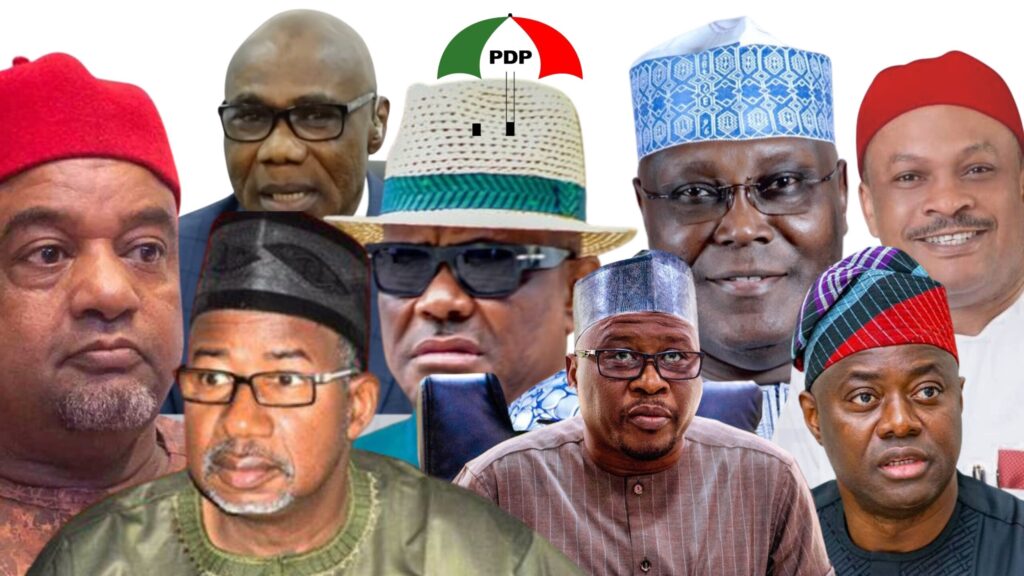
The People’s Democratic Party (PDP), Nigeria’s main opposition force, has been plunged into deeper chaos following its Elective National Convention in Ibadan on November 15, 2025.
In a bold move to cleanse its ranks, the party expelled high-profile figures including Federal Capital Territory Minister Nyesom Wike, former Ekiti Governor Ayodele Fayose, and suspended National Secretary Samuel Anyanwu, citing rampant anti-party activities that have undermined the PDP’s cohesion and electoral prospects.
The convention also elected Kabiru Turaki (SAN) as the new National Chairman, signaling a fresh start under more disciplined leadership.
However, Wike and Anyanwu’s immediate post-expulsion maneuvers—described by critics as “unholy” acts of sabotage—have escalated the crisis, transforming a routine disciplinary action into a full-blown factional war over the party’s soul.
#### The Unholy Actions: A Textbook Case of Defiance and Sabotage
Wike and Anyanwu’s response to their expulsion was swift, audacious, and profoundly destabilizing, revealing a pattern of behavior that prioritizes personal fiefdoms over party loyalty.
Barely hours after the convention’s decisions were announced, Wike’s camp dismissed the entire event as a “kangaroo affair” and “mere jamboree,” lacking constitutional legitimacy and INEC oversight.
This rhetoric wasn’t mere bluster; it was a prelude to action. On November 17, a Wike-loyal faction stormed and seized control of the PDP’s national secretariat at Wadata Plaza in Abuja, barricading entrances and installing parallel leadership structures.
Eyewitness accounts describe tense standoffs, with security forces intervening to prevent violence as Anyanwu himself led the incursion, flanked by loyalists.
Anyanwu, who had already been suspended earlier for alleged complicity in anti-party plots, amplified the chaos by publicly declaring the expulsions “illegal and null,” vowing to challenge them in court while mobilizing state chapters in Rivers, Imo, and other strongholds to reject the new leadership.
This isn’t just defiance—it’s a calculated assault on institutional norms. By physically occupying the secretariat, the duo has disrupted administrative functions, frozen party accounts, and intimidated staff, effectively holding the PDP’s operations hostage.
Their earlier history of anti-party activities—boycotting key meetings, funding rival candidates, and aligning with the ruling APC in critical elections—pales in comparison to this brazen power grab, which reeks of desperation to cling to influence amid Wike’s federal appointment.
These actions are “unholy” not only for their illegality but for their existential threat to the PDP.
They erode public trust, embolden the APC, and fracture alliances in key states like Rivers and Oyo, where the convention also dissolved executive committees to enforce nationwide congresses.
Former PDP Chairman Dr. Robinson Ewor has publicly decried Wike’s tactics as “self-help” that shames Nigeria’s democracy, warning of a potential total collapse if unchecked.
In essence, Wike and Anyanwu are not just fighting expulsion; they are waging war on the party’s democratic fabric.
#### Recommended Steps for PDP: Swift, Decisive, and Reconciliatory
The PDP, under new Chairman Turaki, stands at a crossroads. Expulsion alone won’t suffice—the party’s survival demands a multi-pronged strategy to neutralize the factional threat while rebuilding unity. Here are concrete steps the PDP should prioritize:
1. Legal Fortification and INEC Engagement: Immediately file for interim injunctions in the Federal High Court to restrain Wike and Anyanwu from using party symbols, logos, or facilities, citing violations of the PDP Constitution (Chapter 10 on discipline) and the Electoral Act.
Concurrently, petition the Independent National Electoral Commission (INEC) to derecognize the factional secretariat and affirm the Ibadan convention’s legitimacy, leveraging INEC’s absence at the takeover as evidence of illegitimacy.
This dual approach could resolve the crisis within weeks, preventing prolonged litigation.
2. Security and Administrative Lockdown: Deploy neutral security to reclaim the Wadata Plaza secretariat, coordinating with the Nigeria Police and DSS to evict intruders without escalating violence.
Digitize key operations—finances, membership records, and communications—to insulate against sabotage.
Appoint interim state executives in affected chapters (Rivers, Imo, etc.) to fill the vacuum left by dissolutions.
3. Internal Reconciliation and Anti-Corruption Drive: Convene an emergency National Executive Committee (NEC) meeting within 72 hours to ratify expulsions and launch a transparent audit of party finances, spotlighting alleged misconduct by Wike allies.
Offer olive branches to redeemable fence-sitters, like Rivers Governor Siminalayi Fubara, through mediation committees, but draw red lines against irredeemables like Wike. This balances firmness with inclusivity, crucial for 2027 polls.
4. Public Messaging and Grassroots Mobilization: Launch a nationwide media blitz—town halls, social media campaigns, and endorsements from elders like Atiku Abubakar—to reframe the narrative: “PDP Renewed, Factions Expelled.” Invest in youth and women wings to counter Wike’s street-level influence, emphasizing the party’s role as APC’s credible alternative.
5. Long-Term Structural Reforms: Amend the PDP Constitution to mandate INEC observers at all conventions and introduce recall mechanisms for anti-party offenders. Establish a robust disciplinary framework with time-bound probes to prevent future Wike-like implosions.
If executed decisively, these steps could transform this crisis into PDP’s phoenix moment, emerging stronger and more unified.
Wike and Anyanwu’s gambit may grab headlines, but it won’t rewrite history—the party that once dominated Nigeria’s democracy must now prove it can govern itself.
The clock is ticking; inaction risks irrelevance.
Pamela O.
Political Analyst
Lagos.


