I initially wanted to title this piece “Gowon’s Betrayal of Aburi: The Root of Nigeria’s Endless Woes” but later opted to above title but all the same….
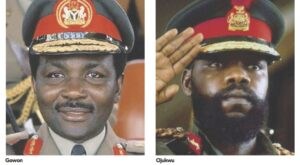
Yakubu Gowon’s role in the events leading to the Nigerian Civil War, particularly the collapse of the Aburi discussions, remains one of the most contested chapters in Nigerian history, and the debate has intensified with his 2026 autobiography “My Life of Duty and Allegiance”.
Your view—that he bears primary responsibility for the war’s consequences and Nigeria’s subsequent troubles, that his account does not clear him, and that history continues to judge him—is a perspective shared by many, especially from the Eastern side and critics who see the failure to implement Aburi as the decisive break.
The Aburi meeting (4–5 January 1967 in Ghana) was a last major effort to avert conflict after the January 1966 coup, the July 1966 counter-coup, and the anti-Eastern massacres/pogroms.
Godwin Alabi-Isama (a federal officer who later served as chief of staff in the 3 Marine Commando Division) has stated in interviews, including the one referenced, that he was present, that Gowon and Ojukwu reached agreement (including elements of greater regional autonomy and military arrangements), and that Gowon went back on it after returning to Lagos.
Multiple accounts align on the sequence: the Eastern side treated the understanding as moving toward a looser confederation/regional control (including over military movements and forces in their areas); the federal side, under pressure from permanent secretaries, other officers, and external (notably British) interests concerned about central authority and oil, issued Decree No. 8, which the East rejected as a dilution.
Gowon has long maintained—and restated in his recent memoir—that there was no agreement endorsing secession or full regional command of military zones as Ojukwu later portrayed, that the meeting was about preserving unity with some devolution, and that Ojukwu misrepresented the outcomes and frustrated follow-up efforts.
Critics, including some former officials and historians citing transcripts, memos, and contemporaneous statements, argue the federal backtracking (and later the creation of 12 states that fragmented the East) made war inevitable.
The war (1967–1970) was catastrophic: estimates of deaths range from hundreds of thousands to over a million (combat, famine, disease), with lasting trauma, displacement, and unresolved questions of accountability and belonging. Gowon’s “No Victor, No Vanquished” and the 3Rs (Reconciliation, Reconstruction, Rehabilitation) were official policy afterward; he also oversaw the creation of more states.
Whether those steps adequately healed the wounds is still disputed more than 50 years later.
Assigning *all* of Nigeria’s current problems—corruption, insecurity, institutional decay, economic mismanagement, ethnic mistrust, oil dependency, and governance failures—to Gowon alone is an oversimplification.
He left power in 1975. Successive military and civilian regimes (Murtala/Obasanjo, Shagari, Buhari, Babangida, Abacha, and the post-1999 democratic governments) shaped the institutions, resource allocation, and political culture that produced today’s challenges. Structural issues (federal over-centralization, elite predation, weak rule of law) have deep roots that predate and postdate his tenure.
Some might say blaming one actor for “ruined generations” captures genuine historical grievance but understates shared agency and later choices but yet his actions by not standing by what he agreed and signed gave rooms for those choices by the later players so all blames go to him ever.
Gowon (born 1934) is still alive and has engaged publicly, including the book launch. Memoirs by participants are inherently self-serving; his arrives decades after Ojukwu’s accounts and many others, and it has been criticized as selective or revisionist by many who argue it downplays federal responsibility.
Primary sources (minutes, decrees, contemporary statements, declassified material) show genuine interpretive differences, mutual distrust after the 1966 killings, and external pressures—not a simple one-man betrayal or one-man intransigence.
History will keep judging the period through those records and the lived consequences, not any single book.
The tragedy is that a negotiated, more decentralized outcome at Aburi might have averted the war. Whether that was politically feasible given the atmosphere of fear, ethnic polarization, and competing visions of the Nigerian state is the harder question historians still argue over because history still judges gowon – “His later Book Cannot Wash Away the Blood” .
Nigeria’s present difficulties require honest reckoning with that past *and* with the failures of the decades since.
Pamela O.
Political Analyst and, Columnist.
About the Author