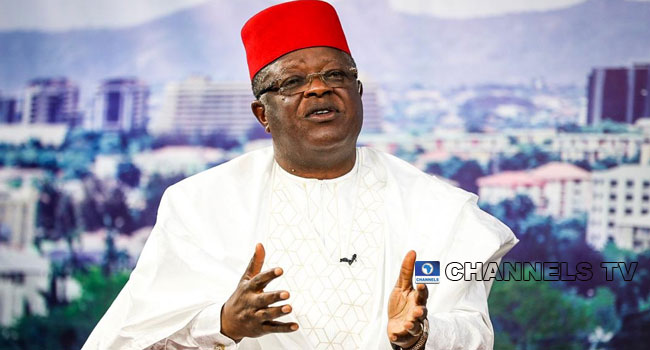
David Umahi’s intra-Igbo grievance politics is a short-term political strategy with long-term costs for Ebonyi and the South-East.
By repeatedly framing other Igbo states as historical or current oppressors of Ndi Ebonyi while directing both rhetoric and visible federal projects toward his home state, the Minister of Works is not merely defending Ebonyi.
He is inviting a reciprocity problem that other Igbo states will eventually use against any Ebonyi candidate who seeks regional or national office.
The latest flashpoint is Umahi’s insistence that it is “not yet the turn of the Igbos” for the presidency, that Peter Obi is not his superior, and that South-East leaders should educate their people so that Obi receives fewer votes in 2027.
He pairs this with claims that President Tinubu has delivered more infrastructure to the region than previous administrations.
Those statements sit on top of an older pattern. After the 2022 APC presidential primary, Umahi accused other South-East delegates of “trading” their votes, declared that “the only agenda I know is the Ebonyi agenda,” said he had lost confidence in Ohanaeze Ndigbo, and stated that Ebonyi people “are not regarded” in the South-East.
He even added that Ebonyi “will never be Biafra.” That is not a one-off outburst; it is a governing narrative.
The video circulating around those remarks captures the same posture: Umahi invoking old grievances that other parts of Igboland have deliberately marginalized or oppressed Ebonyi.
That framing is politically useful inside Ebonyi. It converts federal appointments and road contracts into proof of personal delivery rather than regional inclusion.
It also converts any Igbo who prefers Obi into an implied enemy of Ebonyi progress.
Rhetoric and project direction tell the same story
Umahi’s public record as minister consistently highlights corridors that run through or heavily benefit Ebonyi—the Calabar–Ebonyi–Abuja superhighway sections, Enugu–Abakaliki–Ogoja works, Ndibe Beach linkages, and related concrete-pavement contracts.
Other South-East states receive projects breeze of it unintentionally, sections of the Enugu–Port Harcourt road, Second Niger Bridge access works, and Aba–Ikot Ekpene links.
The political problem is not that Ebonyi finally gets attention after decades of relative neglect. The problem is the accompanying story: that other Igbos withheld that attention and that loyalty to Tinubu, not Igbo solidarity, is what unlocked it.
When a Works Minister from Ebonyi repeatedly contrasts “what we have done for the South-East” with Obi’s record while urging the region not to “throw away” votes on an Anambra son, the message received outside Abakaliki is straightforward: this office is being used first for Ebonyi, then for the ruling party, and only then for a generic “South-East.”
That is how other Igbo states will read it politically. Anambra, Enugu, Imo and Abia already contain their own intra-Igbo resentments—urban versus hinterland, older commercial cores versus newer states, memories of the civil war and post-war reconstruction.
Umahi’s language feeds those memories rather than managing them. Socially, it encourages a defensive Ebonyi identity that treats Igbo presidential ambition as an Anambra project.
Politically, it weakens the South-East’s already thin collective bargaining power. A region that cannot present a united front on zoning, appointments or infrastructure is easier to pick off state by state.
Reciprocity is not a slogan. It is how Nigerian politics actually works
The user’s warning is the most important part of the argument. If large parts of Igboland treat an Anambra candidate as illegitimate simply because he is from Anambra, they are writing a precedent.
The next time an Ebonyi politician seeks a South-East consensus ticket, or national office, the reply will write itself: “You told us it was not our turn. You told us other Igbos oppressed you. You used federal power for Ebonyi first. Why should we annex your ambition now?”
Nigerian politics keeps receipts. Umahi and those cheering him should remember that patronage is not a permanent shield.
Nigerian political memory is long and transactional. Delegates who “traded votes” in 2022, voters who backed Obi in 2023, and governors who later calculated their own survival will all keep receipts.
Umahi’s current posture—support Tinubu, reduce Obi’s vote, celebrate Ebonyi-specific delivery—makes those receipts easier to cash.
Other states will not need to invent a new grievance. They will quote him.
A message to Umahi and those who cheer the division
You can deliver roads in Ebonyi without teaching Ebonyi that the rest of Igboland is the obstacle.
You can serve a president without declaring that Igbo presidential timing must wait until that president is finished.
You can criticise Peter Obi’s record without converting an intra-Igbo contest into a morality play about who “oppressed” whom.
The Ebonyi people who applaud this line should ask a narrower question: what happens when Umahi is no longer Minister of Works?
Patronage is not a permanent shield. A politics built on intra-Igbo suspicion leaves Ebonyi isolated the moment the current alignment changes.
Other Igbo states will react first with irritation, then with electoral payback, and finally with social distance—less cooperation on trade, less willingness to treat Ebonyi candidates as regional standard-bearers, more willingness to treat Ebonyi as a special case that opted out of the common project.
Igbo political strength has never come from one state’s monopoly on grievance. It has come from the ability to convert five states, however imperfectly, into a bloc that others must negotiate with.
Umahi’s rhetoric and project emphasis move in the opposite direction. That may win him applause in Abakaliki today.
It will make the next Ebonyi ambition harder to sell everywhere else tomorrow.
Pamela O. Political Analyst and Columnist.
About the Author