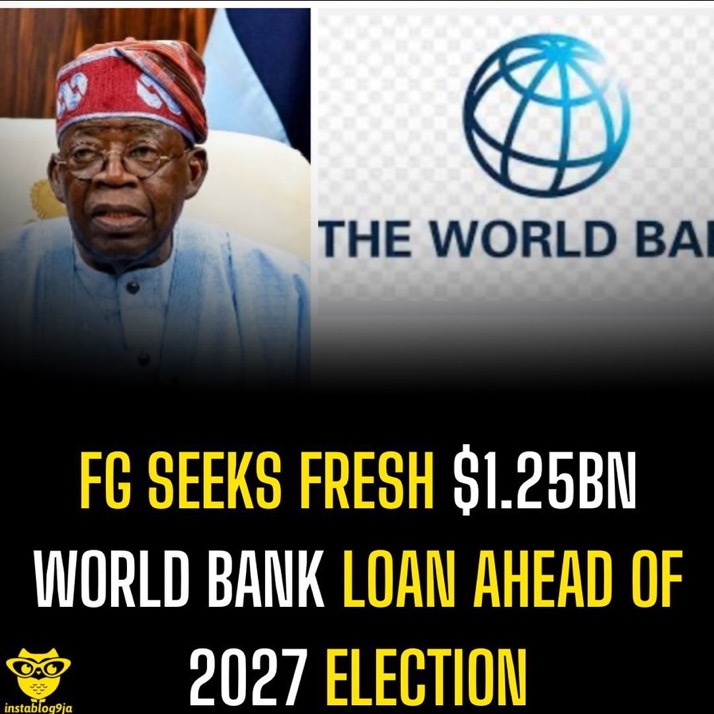
As Nigeria groans under the weight of yet another borrowing binge, President Bola Ahmed Tinubu’s administration has once again turned to the National Assembly with outstretched palms.
Just weeks ago, lawmakers rubber-stamped a fresh $516 million syndicated loan from Deutsche Bank to kick-start the first leg of the Sokoto-Badagry Superhighway — a grand corridor that, conveniently, terminates in the heart of Lagos, the president’s political and economic stronghold.
This comes hot on the heels of the National Assembly’s approval of a $6 billion external borrowing package in March 2026: $5 billion from First Abu Dhabi Bank for “budget support and infrastructure” and $1 billion backed by UK Export Finance explicitly earmarked for rehabilitating the Lagos Port Complex and Tin Can Island Port — both sitting squarely in Tinubu’s Yoruba heartland.
Let us be blunt. Since Tinubu took office in 2023, Nigeria’s public debt has ballooned from roughly ₦87 trillion to over ₦159 trillion by December 2025, with fresh approvals pushing the figure toward ₦195 trillion and beyond.
The administration has secured multi-billion-dollar facilities for 2025–2026, including a sweeping $21 billion external borrowing plan approved last year.
These are not abstract figures. Every naira borrowed today is a chain around the neck of unborn Nigerians who will service it through higher taxes, inflation, and austerity.
The real scandal, however, is not the borrowing itself — every government borrows — but the glaring regional skew of the projects it funds.
Time and again, flagship initiatives under Tinubu funnel resources toward the Southwest, his ethnic base, and particularly Lagos, the commercial capital he once governed.
The Lagos ports rehabilitation? Direct economic lifeline to the Yoruba commercial elite. The Sokoto-Badagry highway? A shiny new artery designed to feed goods, people, and revenue straight into Lagos and its environs.
Critics have long pointed to this pattern: massive coastal highway projects, port upgrades, and urban rail initiatives that disproportionately bless the president’s region while the rest of the federation picks up the tab.
Even defenders of the administration struggle to mask the optics. While some claim the Northwest has received a larger share of approvals in raw naira terms, the high-visibility, high-impact projects — the ones that generate immediate revenue, jobs, and political capital — cluster around
Tinubu’s people and power base. The narrative of “national integration” rings hollow when the debt incurred serves narrow regional interests first.
And then there is the darker allegation that refuses to die: that portions of these loans have quietly greased the wheels of political survival, including Tinubu’s re-election machinery.
In a country where governance and campaign finance have long blurred into one expensive continuum, borrowed billions have a way of finding their way into patronage networks, media buyouts, and vote-buying logistics. Whether proven in court or not, the perception is toxic — public money borrowed at crushing interest rates to keep one man and his tribe in power.
Here is the uncomfortable truth this column has the courage to state:
if the projects are centered on Tinubu’s tribe, region, and political family, then let that same tribe, region, and family service the debt. National revenue — drawn from oil in the Niger Delta, taxes from the North, and sweat from every corner — should no longer subsidize what amounts to ethnic infrastructure pork.
Future administrations must ring-fence debt servicing for these Southwest-centric projects and demand that revenue streams generated by them (tolls on the new highway, tariffs at the upgraded Lagos ports) flow directly into repayment accounts. No more nationalizing the cost while regionalizing the benefit.
Better still: the ultimate accountability must fall on the man who signed the cheques. Subsequent governments should have the constitutional spine to treat President
Tinubu’s vast personal investments, properties, and business empire — built over decades in Lagos and beyond — as collateral of last resort. Sell the private jets, the offshore holdings, the prime real estate, the corporate stakes.
Let the operation of his personal assets, not the pockets of cassava farmers in Benue or fishermen in Bayelsa, generate the cash to service the loans he took in the name of “renewed hope.”
Nigeria cannot continue this charade of borrowing for the few while the many pay. The debt is real. The projects are selective. The pain is national.
It is time to stop pretending otherwise. If Tinubu’s vision is truly for “his people,” then let his people — and his personal fortune — bear the burden. Anything less is fiscal treason.
Pamela O., political analyst and commentator.
About the Author