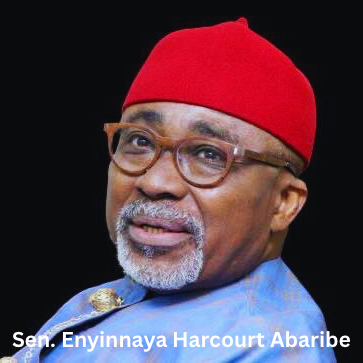
In Nigeria’s National Assembly, where compromise often masquerades as consensus and silence is frequently mistaken for wisdom, Senator Enyinnaya Harcourt Abaribe stands out as a consistent disruptor. For nearly two decades, he has rocked the boat — challenging executive overreach, questioning security failures, pushing for accountability, and speaking uncomfortable truths on behalf of his people and the broader South East.
The systems he confronts have now mounted a counter-offensive, weaponising his longevity in the Senate while conveniently ignoring far longer-serving colleagues. The selective noise over his defections and tenure reveals a deeper discomfort: the discomfort of vested interests whose plans he continues to rumple.
Abaribe entered the Senate in 2007. He has served approximately 19 years. Yet veterans like Senator Ahmad Lawan (over 27 years across House and Senate), Senator Ali Ndume (over 23 years), and several others with unbroken or near-unbroken decades in the National Assembly face no orchestrated campaigns demanding they “step aside for the youth.”
The double standard is glaring. Longevity is praised as institutional memory when aligned with power; it becomes a liability only when the lawmaker refuses to play ball.
The same hypocrisy applies to defections. In early 2026, multiple senators crossed carpets — many citing party crises in PDP, LP, or elsewhere — with minimal scrutiny. Abaribe’s shift from APGA to ADC, and subsequently to the Labour Party, triggered intense debate and threats of seat vacation under Section 68. APGA cried foul.
Senate leadership singled him out. Yet as others defected in waves and the political realignment continued, the outrage evaporated. This was never truly about constitutional purity. It was about neutralising a vocal opposition figure who refuses to be co-opted.
Abaribe has earned powerful enemies precisely because he disturbs comfortable arrangements.
He has moved motions on insecurity, challenged executive decisions, sponsored bills for regional development (including the Federal University of Petroleum and Geological Sciences in Ukwa West), and consistently amplified Igbo concerns in a chamber where many prefer bench-warming or belly politics.
In a Senate often criticised for executive compliance, such independence is threatening. The “sponsored outrage” — amplified by rivals eyeing his seat — seeks to paint him as outdated. But his people know better.
Constituency Impact and Enduring Mandate
Abaribe’s record of delivery in Abia South underscores why his return is crucial. At town halls, he has highlighted tangible achievements: solar-powered streetlights across 139 communities, rehabilitation of key roads like Opobo–Azumini, investments in power infrastructure (including a ₦235 million 33KVA transmission line), youth and women empowerment programmes, school interventions, and facilitation of federal recruitments.
These are not abstract; they represent sustainable development in a region hungry for visible progress.
His constituents in Abia South, and broader Igbo stakeholders, have repeatedly affirmed his mandate. Despite pockets of criticism, the Labour Party’s 2027 primaries delivered him a landslide ticket for Abia South.
Supporters describe him as not just an Abia South senator, but an Igbo senator — one who speaks for collective interest in a National Assembly where South East voices are often marginalised.
The people are saying “No” to the selective vendetta. They recognise that experience, institutional knowledge, and fearless representation matter more than recycled rhetoric about generational change, especially when selectively applied.
Why His Return Matters
In a National Assembly where many prioritise personal comfort over confrontation, Abaribe’s presence ensures critical issues — insecurity, equitable federal projects, power sector reform, and regional equity — remain on the front burner.
His independence prevents the chamber from descending into total echo-chamber status. Abia South voters understand this. They gave him the mandate before; they will renew it in 2027, undeterred by sponsored campaigns.
The systems he fights know the threat he poses. That is why longevity and defection have become convenient cudgels against him alone. But Nigerian democracy thrives not on conformity, but on robust voices.
Senator Abaribe’s resilience, proven delivery, and unwavering representation make his continued service not just desirable — but essential. The selective outrage will fade, as it always does when the people speak. Abia South, and indeed the South East, are poised to send him back to continue the work.
Pamela O. Political Analyst and Columnist
About the Author