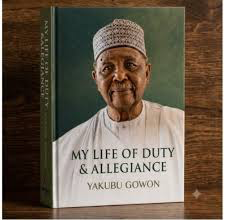
General Yakubu Gowon’s 881-page memoir, “My Life of Duty and Allegiance”, was positioned as a late-life reckoning—an elder statesman’s final word on the events that led Nigeria into the 1967–1970 civil war.
Instead, the book, launched in 2026, has sharpened long-standing questions.
Read against the documented record of the July 1966 counter-coup, the Aburi talks, the conduct of the war, and its aftermath, its pages contain internal tensions that undercut the narrative of reluctant federal duty, spontaneous northern reaction, and genuine reconciliation.
The contradictions do not require external invention; they arise from the text’s own claims when set beside contemporary accounts, tapes, other memoirs, and established historical estimates.
The phantom rescue of Ironsi.
On page 201, Gowon describes an impulsive effort to evacuate Supreme Commander Aguiyi-Ironsi from Ibadan by helicopter via Major Paul Dickson at Ikeja. No such major appears in the Nigerian Armed Forces rolls for 29 July 1966; the only Paul Dickson then present was an Air Force staff sergeant whose duties were far more limited.
The story of attempted rescue sits uneasily beside accounts of the same day. Lindsay Barrett’s biography of T.Y. Danjuma records a telephone exchange in which Danjuma reports that Ironsi’s residence is surrounded and sealed, Gowon asks whether the arrest can be effected, and, after pauses, authorizes it while urging “no bloodshed.”
Danjuma later stated publicly that control was lost after the arrest. The memoir’s helicopter episode distances Gowon from the transfer of power and the subsequent killings of Igbo officers and civilians; the contemporaneous exchange places him at the authorization point. The two versions cannot both be the full story of that day.
Aburi, the fever, and the broken agreement.
Gowon signed the Aburi Accord in Ghana in January 1967, then returned and saw it undone. The memoir and subsequent interviews invoke a “shivering fever” that left him unable to decide or respond promptly upon return.
The Aburi proceedings were taped. Participants and later listeners have described Gowon as lucid and engaged during the sessions themselves. Upon return, Decree No. 8 introduced a Head of State veto that altered the balance struck at Aburi. Gowon has also stated that Ojukwu’s demands on military zoning went beyond what was acceptable. The fever alibi, offered decades later, functions as a medical explanation for a political reversal whose consequences are clear: the last structured opportunity for a confederal or more decentralized settlement was not implemented, and the narrative presented to the North was one of Igbo aggression rather than a signed agreement later modified in Lagos. The tapes remain available for comparison with the memoir’s account.
Thousands” against the scale of loss.
On page 467 the memoir refers to the war’s victims as “thousands who perished.” Standard historical estimates place total deaths between roughly 500,000 and 3 million, with the largest share among Biafran civilians from starvation and disease under the federal blockade; figures of one to two million or higher are common in scholarly and reference sources.
Babangida’s own memoir has cited more than two million Biafran civilian deaths from starvation and disease alone. “Thousands” is not a neutral rounding; it compresses a catastrophe whose most visible and internationally reported feature was mass hunger.
The blockade is treated in the memoir as strategic necessity; the human arithmetic is minimized. The discrepancy is arithmetical and moral at once.
The framing and partial exoneration of Ironsi.
Across pages 164–166, 172–173 and 188–189, the memoir implies that Ironsi “must have known” of the January 1966 coup and thereby shared responsibility. That implication supplied a justification narrative for the counter-coup and the northern pogroms.
Later in the same volume (around page 185) the implication is withdrawn. The sequence—accusation planted where it could legitimate rage, then quietly reversed—is difficult to read as simple memory error. It allowed the North to be told that the Supreme Commander and, by extension, the Igbo community were implicated, while a quieter passage preserved a narrower factual claim.
The blockade’s ordinary consequences and the slogan of reconciliation.
The memoir treats the blockade primarily as military measure and starvation as wartime byproduct. It devotes space to command decisions, diplomacy, and cabinet process; it gives far less to the documented obstruction of relief, the progressive famine inside the enclave, and the daily deaths of civilians, especially children.
Post-war, the declaration “No victor, no vanquished” is presented as generous intent.
In practice, former Biafrans encountered the £20 banking limit, seizure of abandoned property, uneven reconstruction spending, and a federal structure that centralized power with the victors. The slogan facilitated national closure without full accounting; the East carried the longer material and demographic cost. The memoir does not reconcile the language of equality with those outcomes.
These tensions are not peripheral. They concern the authorization of Ironsi’s arrest, the fate of the last peace framework, the scale of civilian death, the narrative justification offered to the North, and the meaning of the war’s ending.
The North was given a story of reluctant defence of unity and spontaneous reaction to January’s killings.
The memoir’s own pages, read against the tapes, other officers’ accounts, and the numerical record, show calculated choices, a reneged agreement, and a minimized toll.
General Gowon, many who lived through the counter-coup, the pogroms, Aburi, the blockade, and the fighting are still alive. Others—Danjuma, Babangida, and additional participants—have already set down their pieces.
Historians continue to interrogate the contradictions page by page and tape by tape, not as abstract scholarship but because more than a million innocent souls, overwhelmingly civilians and children, perished.
At ninety-one, with the memoir already in the public record, the remaining opportunity is to come clean: to align the account with the authorization, the Aburi tapes, the actual death toll, and the post-war realities rather than the protective narrative that has stood for sixty years.
The dead cannot speak; the living witnesses and the documentary record can still force the truth.
–Pamela O.
About the Author