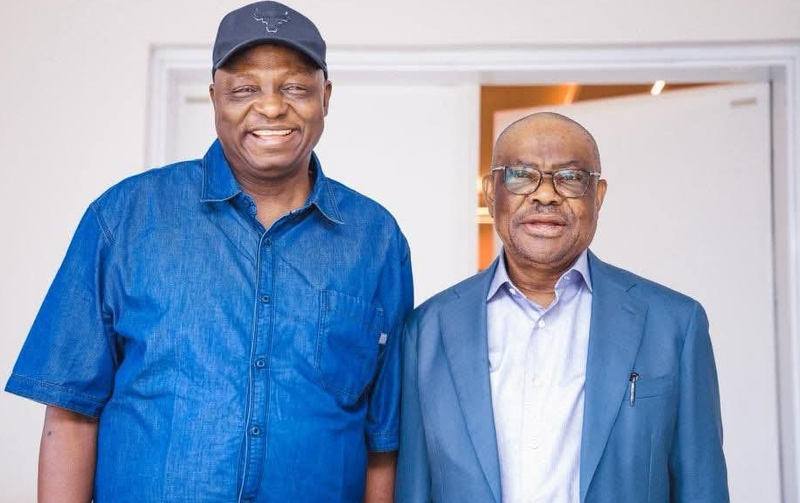
APC National Chairman Prof. Nentawe Yilwatda’s recent declaration that he will not support anyone outside the APC, and that the party’s governors must back only APC candidates, is less a surprise than a clarifying statement of institutional self-interest.
Delivered amid the debate over Nyesom Wike’s Rainbow Coalition, it restates a basic rule of party politics: a governing party does not systematically underwrite the electoral fortunes of candidates flying other flags, even when those candidates claim to be mobilising for the same presidential ticket.
Wike, the FCT Minister and a PDP figure, has positioned the Rainbow Coalition as a vehicle for President Bola Tinubu’s 2027 re-election.
Participants keep their party identities and can support candidates of their choice in governorship, National Assembly and state assembly contests.
APC governors, through the Progressive Governors’ Forum led by Hope Uzodimma, have rejected arrangements they say could weaken the party or hurt its candidates.
Yilwatda has aligned with that stance for APC itself and its governors while noting that he cannot dictate to non-members such as Wike.
He has also said he is not opposed to anyone who wants to support Tinubu.
This leaves Wike’s collaboration in a more constrained space. The coalition can still function as a parallel mobilising network for the presidential vote, drawing on Wike’s residual influence in Rivers, aggrieved politicians from various parties, and those who prefer not to defect formally.
What it cannot expect is active APC institutional endorsement or governor-level machinery working for non-APC candidates down the ballot.
Where APC governors control state structures, the instruction is clear: promote the party’s own candidates from top to bottom.
Parallel structures that compete with APC candidates at sub-presidential levels are therefore treated as a threat rather than an asset.
The practical effect is a sharper distinction between support for the President and support for the APC as an organisation.
Wike has long maintained that the two are separable; he remains in the PDP (described by some as “on loan” to the administration) and has not promised to deliver the full ticket. Yilwatda’s position accepts the former while refusing to dilute the latter.
In states where APC is dominant or where governors have strong incentives to protect their own re-election or succession plans, this makes cross-party ticket-sharing harder.
In places like Rivers, where Wike retains substantial local leverage and Governor Siminalayi Fubara has moved into APC, the tensions between formal party leadership and residual personal/structure politics are likely to persist.
Yilwatda has previously indicated that such differences can be managed through dialogue.
That remains the preferred channel rather than open confrontation, given Wike’s role in the federal government and his demonstrated capacity to deliver on infrastructure and political tasks in the FCT.
Yet the chairman’s latest remarks reduce the ambiguity that the Rainbow Coalition thrives on.
They signal to APC governors, aspirants and structures that party loyalty is not optional when the party itself is on the ballot, and they signal to Wike that his value to the Tinubu project is primarily presidential and administrative, not as a free-floating broker of mixed tickets.
For the coalition, the space that remains is informal, state-specific and dependent on local power balances rather than national APC cover.
It can still help consolidate votes for Tinubu in areas where pure APC machinery is weak or where opposition is fragmented. It cannot, under Yilwatda’s formulation, expect the ruling party to subordinate its own candidates to coalition preferences.
That is the boundary that has now been drawn more clearly, and it is the one that will shape how much real collaboration is possible between now and 2027.
Daily Buzzwire.
P.O
About the Author