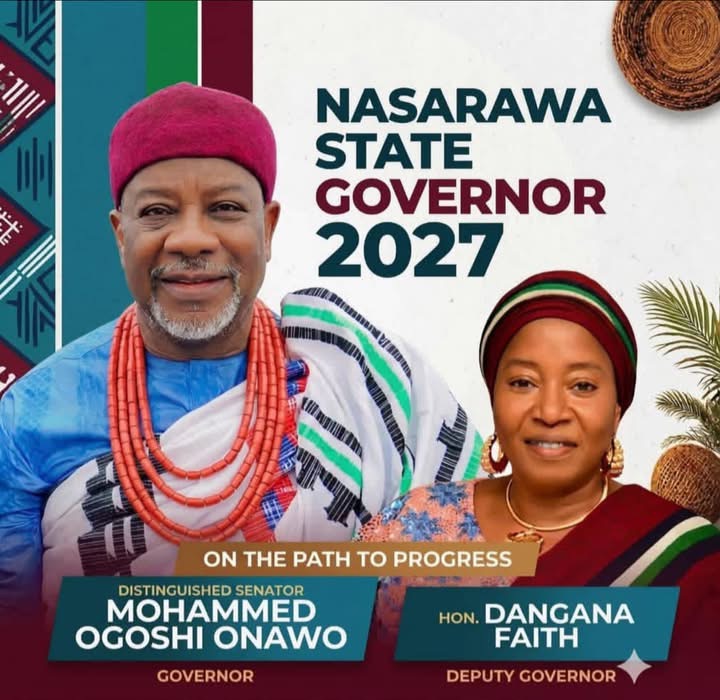
In the unfolding 2027 governorship contest, the Allied Peoples Movement has positioned Senator Mohammed Ogoshi Onawo and his running mate as a break from the ruling All Progressives Congress’ pattern of continuity through anointing.
Onawo, the senator for Nasarawa South, emerged as APM’s candidate in mid-September 2026 after the party’s state chairman stepped aside in a consensus process.
He presents himself as the most experienced contender, with service as two-term speaker of the Nasarawa State House of Assembly, two-term member of the House of Representatives, and now senator. That record, combined with a grassroots base in the South, allows APM to frame the ticket as competent, inclusive, and free of the godfather politics that now define the APC.
The APC ticket, by contrast, carries the weight of Governor Abdullahi Sule’s public endorsement of Senator Ahmed Aliyu Wadada as his preferred successor. Sule announced the choice after consultations he described as exhaustive, narrowing the field to three before settling on Wadada from Nasarawa West. Vice President Kashim Shettima later reinforced the pick. Wadada, who defected from the SDP to the APC, won the party’s direct primary and has since been paired with Emmanuel Michael Ombugadu as running mate.
Supporters call this continuity of Sule’s industrialisation and infrastructure efforts. Critics see it as classic imposition: a sitting governor engineering his replacement to protect legacy and influence after leaving office.
That perception has already fractured the APC. Former Governor Umaru Tanko Al-Makura publicly criticised the early endorsement as hasty and an “aberration” that bypassed proper stakeholder consultation.
Former Inspector-General of Police Mohammed Adamu, who came second in the APC primary, left for the SDP.
Ethnic nationality groups protested the lack of wider consultation. Zoning arguments—whether power should rotate back to Nasarawa West after two decades—have sharpened rather than settled internal tensions.
Analysts note that unresolved godfatherism and personal rivalries now risk anti-party voting and litigation. After eight years of Sule (following Al-Makura’s tenure), the ruling party looks less like a united machine and more like a coalition straining under succession politics.
Onawo and APM have exploited that opening. After leaving the PDP and then the ADC—where he lost a primary many described as manipulated—Onawo joined APM and immediately declared for governor.
The party’s special congress in Lafia affirmed him by acclamation across the 13 local governments. He has pledged an issue-based campaign focused on security, infrastructure, agriculture, education and job creation, while stressing the need to unite Nasarawa’s diverse ethnic and religious communities.
APM, a relatively newer platform, presents itself as unencumbered by the incumbency baggage and internal wars of the APC. Onawo’s legislative experience and Southern base give the ticket geographic and political balance that the APC’s West-South pairing has not fully resolved in the eyes of many stakeholders.
The larger population’s excitement stems from a simple calculation: after years of APC dominance, voters see a chance to reject both perceived stagnation and a hand-picked successor.
Sule’s administration has delivered some rural roads, agricultural policy launches and increased federal allocations after subsidy removal. Yet opposition narratives emphasise unfulfilled expectations around jobs, security in border communities, and inclusive development. The anointing of Wadada reinforces the sense that the next four years would be more of the same—continuity without a fresh mandate.
Onawo’s emergence on a different platform offers an escape hatch: an experienced politician who is not the product of Government House selection. In a state known for its ethnic mix and proximity to the FCT, that option resonates with those tired of zoning battles and elite bargains.
Whether APM can convert that sentiment into votes remains the test. Nasarawa’s electorate has shown it can punish incumbents and former governors alike. Onawo’s strength in the South, combined with APM’s promise to offer a cleaner alternative, positions the ticket as the vehicle for those who want change without returning to the PDP or scattering votes among smaller parties.
For now, the contrast is clear: one side offers continuity under a governor’s chosen heir; the other offers an experienced senator on a new platform promising unity and delivery. That choice is what has generated the visible energy around APM in the state.
Daily BuzzWire
About the Author