
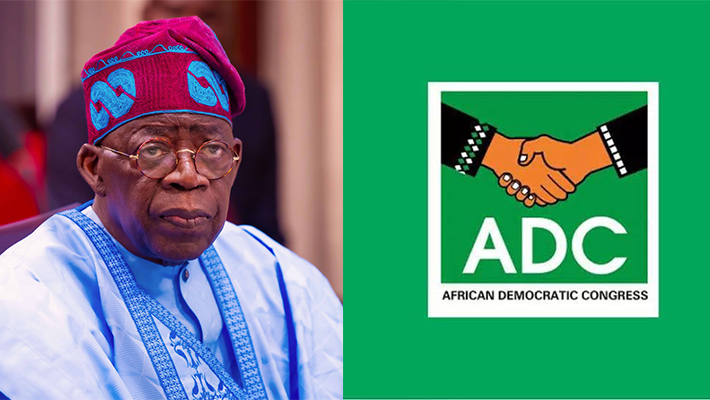
President Bola Ahmed Tinubu’s administration is approaching the 2027 elections amid a storm of accusations that it is not just competing with the opposition but actively fracturing it.
The core claim making rounds in political circles – and echoed by figures like former Senate President David Mark of the African Democratic Congress (ADC) and Labour Party chieftain Gbadebo Rhodes-Vivour – is blunt: if Tinubu’s performance as administrator had been convincingly strong, the ruling All Progressives Congress (APC) would not need to fear a united opposition. Instead, the playbook appears to be one of pre-emptive destabilisation – sowing crises in rival parties to neutralise credible challengers, leaving only a weak or aligned “stooge” on the ballot.
The Wike-led faction of the Peoples Democratic Party (PDP) is widely seen as playing that role, while the ADC-led coalition insists it will never allow a walkover.
And the irony? The same factional wars the APC is accused of exporting are already festering within its own ranks.
Tinubu’s Record: Reforms That Hurt Before They Helped?
No serious analysis can ignore the economic pain that defined Tinubu’s first three years. The removal of fuel subsidies and unification of exchange rates were bold reforms long advocated across party lines, but they triggered immediate inflation spikes, naira volatility, and widespread hardship.
Approval ratings reflected this: they plunged to as low as 11% in early 2024 before climbing back to the 40-51% range in some 2025-2026 polls (NOI Polls and others), with dips to 37% in mid-term assessments.
Supporters point to infrastructure projects, oil sector stability gains, and gradual macroeconomic recovery as evidence of stewardship.
Critics – including large sections of the opposition – argue that cost-of-living crises, insecurity, and youth unemployment have left millions disillusioned.
The political implication is straightforward. A president with sky-high approval and visible broad-based gains would not need to obsess over opposition disarray.
Strong incumbents win re-election on record, not by default. The fear now evident in the APC suggests the administration calculates that its performance alone may not be enough against a credible, united alternative. Hence the alleged shift from governance to political engineering.
The Wike PDP Faction: Tinubu’s “Adopted” Opposition?
One faction of the PDP, led by FCT Minister Nyesom Wike, has openly positioned itself as a Tinubu ally. Wike has repeatedly declared he will “support President Tinubu for a second term.”
Reports from March-April 2026 detail the Wike camp organising structures, floating a “Rainbow Coalition” in Rivers State that blends PDP and APC elements, and even scheduling primaries explicitly to sideline northern PDP blocs that might challenge Tinubu.
BusinessDay and other outlets have framed this as the PDP faction effectively preparing to adopt or at least not seriously oppose Tinubu’s re-election bid.
This is the scenario opposition voices fear: Tinubu running not against a genuine PDP candidate but against a handpicked or token representative from a splinter faction already in his corner.
It would turn the presidential race into something closer to a coronation than a contest.
ADC and the Real Opposition: “We Will Never Allow It”
The African Democratic Congress has emerged as the clearest counterweight. A coalition built around heavyweights – Atiku Abubakar, Peter Obi, Rotimi Amaechi, and others – the ADC has absorbed defectors, taken over minority leadership in the Senate, and vowed to contest 2027 on its platform.
David Mark, its chairman, has accused the Tinubu government of “destroying opposition political parties” and using state institutions (courts and INEC) to create leadership crises.
Recent INEC actions removing Mark and Rauf Aregbesola’s names from its portal, citing court orders, have triggered street protests and fresh allegations of partisanship.
ADC leaders insist they will resist any drift toward a one-party state “in our generation.”
Northern PDP leaders and other opposition blocs have reportedly held talks with the ADC as the preferred vehicle.
The message is clear: they will not accept a ballot dominated by Tinubu and a Wike-aligned PDP remnant.
APC’s Own Factions: The Boomerang Effect
The irony is not lost on observers. While the APC denies orchestrating opposition crises – insisting parties should “resolve their internal disputes” – the ruling party itself has required high-level intervention.
President Tinubu inaugurated a Strategy, Conflict Resolution and Mobilisation Committee precisely to manage internal APC disputes ahead of 2027.
Factional tensions over zoning, godfatherism, and consensus candidacies persist. The very tactics allegedly used to weaken outsiders risk rebounding inward: once you normalise institutional meddling in party affairs, the precedent does not stay confined to the opposition.
The Bigger Picture: Performance vs. Power Retention
The user’s premise holds analytical weight. In a functioning democracy, strong governance reduces the incentive for desperate political sabotage.
When voters feel tangible improvement in their lives, incumbents sleep easier.
The current frenzy of defections, leadership litigations, and mutual accusations suggests the APC calculates that performance metrics alone are insufficient.
Opposition leaders like Rhodes-Vivour openly state that Tinubu, sensing the odds against him, is “creating an environment where he is the only candidate on the ballot.”
Yet the APC and Presidency push back hard: these are self-inflicted opposition wounds, not presidential plots. Tinubu himself has publicly rejected any “one-party state” agenda, insisting “democracy thrives on vibrant and healthy competition.” Whether the crises in the PDP and ADC are organic or engineered will ultimately be tested in the courts, at the polls, and in public perception.
What is undeniable is this: a fragmented opposition is easier to beat. But a fragmented opposition also weakens accountability.
If Tinubu’s administration has indeed performed well enough to earn re-election on merit, the opposition crises should be irrelevant.
The fact that they have become central to the 2027 conversation suggests the real contest is not yet about results – it is about who gets to define the battlefield.
The ADC and non-Wike PDP elements are determined not to let that battlefield be cleared in advance. The coming months will reveal whether the opposition can consolidate despite the fractures, or whether the strategy of induced chaos succeeds. Nigeria’s democracy hangs in the balance either way.
About the Author


