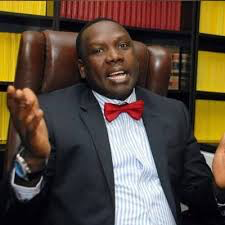
In the kaleidoscope of Nigerian politics, where loyalty is often a currency traded for personal gain, Daniel Bwala stands out as a master of reinvention. A lawyer by training and a political operative by choice, Bwala has carved a niche for himself as a figure whose allegiances shift with the winds of opportunity. To call him a two-faced political jobber might seem harsh to some, but his track record suggests a man whose principles are as fluid as the ink he once used to argue cases in courtrooms. Today, as a columnist peering into the murky waters of Nigeria’s political landscape, I find Bwala’s chameleonic support for politicians a fascinating, if troubling, case study in opportunism.
Bwala’s political odyssey reads like a script from a Nollywood drama—full of twists, betrayals, and sudden reconciliations. He first gained prominence as a vocal supporter of the All Progressives Congress (APC), defending its policies and personalities with the fervor of a true believer. Yet, in July 2022, he dramatically parted ways with the party, citing the Muslim-Muslim ticket of Bola Tinubu and Kashim Shettima as an affront to his Christian convictions. It was a bold stance, one that earned him applause from those who saw it as a rare display of principle in a country where religion often trumps reason in political discourse. But the applause had barely faded when Bwala resurfaced as the spokesperson for Atiku Abubakar, Tinubu’s rival in the 2023 presidential race under the Peoples Democratic Party (PDP). Suddenly, the man who decried religious exclusion was championing a northern candidate, conveniently sidestepping the ethnic tensions within his new political home.
Fast forward to 2024, and Bwala’s chameleon-like transformation reached its zenith. After Tinubu’s victory, he made a stunning U-turn, pledging allegiance to the very administration he had once vilified. His appointment as Special Adviser on Public Communications and Media by President Tinubu in November 2024 cemented this shift, turning yesterday’s critic into today’s cheerleader. Bwala dismissed his past criticisms with a shrug, claiming they were mere opposition rhetoric—irrelevant now that he had seen the light. To his detractors, this was not an epiphany but a calculated grab for relevance; to his supporters, it was a pragmatic move to serve the nation. Whichever lens you choose, the pattern is undeniable: Bwala’s loyalty is a garment he tailors to fit the occasion.
What drives this political shape-shifting? Some argue it’s survival—a necessity in a system where power is the ultimate prize and ideology a distant afterthought. Nigerian politics, after all, is less about manifestos and more about stomachs, as the late Professor O.B.C. Nwolise famously quipped. Bwala himself has hinted at this, framing his moves as a commitment to whoever holds the reins of power at any given time. Yet, this justification rings hollow when one considers the trail of followers he has swayed with his eloquence, only to abandon when the next opportunity beckons. His strategies—sharp-tongued critiques one day, glowing endorsements the next—reveal a man adept at playing both sides of the fence, a political jobber whose only constant is self-preservation.
Bwala’s chameleonic nature is not without cost. His credibility, once bolstered by his legal acumen and media savvy, now hangs by a thread. Nigerians on social media have not been kind, unearthing old tweets where he mocked the APC only to now sing its praises. Critics like Senator Ali Ndume have called him a “failed lawyer” with “no political relevance,” while others see him as a symbol of everything wrong with our democracy—a system that rewards adaptability over integrity. Even within Tinubu’s camp, some view his zeal as that of an overeager convert, desperate to prove his worth after years of opposition.
As a columnist, I’m left to ponder: Is Daniel Bwala a villain or a victim of circumstance? Perhaps he’s neither—just a product of a political culture that thrives on expediency. His strategies may win him seats at the table, but they also paint a portrait of a man who, in wearing so many faces, risks losing sight of his own. In a nation crying out for leaders with conviction, Bwala’s legacy may well be that of a chameleon—brilliant in its adaptability, but forever elusive in its true colors.
—
About the Author