
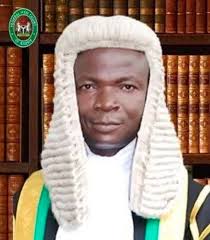
Judge Omotosho
In the high-stakes arena of Nigerian politics and justice, few names evoke as much passion, outrage, and debate as Justice James Omotosho.
Appointed to the Federal High Court in Abuja in 2017, this 59-year-old jurist has become synonymous with lightning-fast rulings on politically explosive cases.
But is Omotosho a quick fire judge delivering swift justice, or is he Tinubu’s hedge man—a loyal enforcer shielding President Bola Tinubu’s administration from its critics?
As Nigeria grapples with judicial independence under Tinubu’s presidency, Omotosho’s legacy hangs in the balance. This article explores his rise, controversies, and the historical verdict that may define him as a man of the moment, ready to do the bidding of the present government while seated on the bench.
Who Is Justice James Omotosho? From Lagos Roots to Abuja’s Judicial Hot Seat
Born on July 21, 1966, in Ijemo-Abeokuta, Ogun State, but raised in the bustling Ajegunle neighborhood of Lagos, Justice Omotosho embodies the grit of Nigeria’s urban underbelly. He earned a degree in Economics and Business Management from Lagos State College of Education before pursuing law at Olabisi Onabanjo University. His pre-judicial career in public service honed his administrative acumen, but it was his elevation to the Federal High Court that thrust him into the national spotlight. Omotosho’s docket reads like a who’s who of Nigeria’s political fault lines.
Since Tinubu’s 2023 inauguration, his court has become a magnet for cases testing the boundaries of executive power, often resolving them with unprecedented speed—earning him the moniker quick fire judge.
Critics, however, whisper of “à la carte law,” where rulings seem tailor-made to favor federal interests, particularly those aligned with Tinubu’s inner circle, like FCT Minister Nyesom Wike.
As one analyst put it, Omotosho’s decisions often appear “deeply solicitous” of the administration, raising alarms about judicial bias in a nation where trust in the courts is already fragile.
The Rivers State Saga: Omotosho as Wike’s Judicial Shield?
No case better illustrates the Tinubu hedge man narrative than Omotosho’s handling of the Rivers State political crisis.In March 2025, President Tinubu declared a state of emergency in Rivers amid escalating tensions between Governor Siminalayi Fubara and Wike’s loyalists. Over 40 lawsuits flooded courts in Abuja, Port Harcourt, and Yenagoa, challenging the declaration’s legality.
Enter Omotosho. A suit filed in Port Harcourt (FHC/PH/CS/53/2025) mysteriously migrated to his Abuja courtroom, where he ruled on April 22, 2025, dismissing challenges and famously declaring Fubara “should be grateful” the emergency ended.
Later, on October 22, he struck again, voiding state appropriations and restraining Fubara from “frustrating” Wike’s faction in the House of Assembly. These weren’t isolated; multiple Rivers-linked matters “inexplicably” landed on Omotosho’s desk, fueling accusations of docket-fixing by the Chief Judge of the Federal High Court. Legal scholar Chidi Anselm Odinkalu lambasted these as “à la carte judicial orders,” portraying Omotosho as a “judicial Man Friday” to Wike and, by extension, Tinubu.
Social media echoed the fury: X users branded him a “Tinubu puppet,” with posts decrying how his rulings propped up the federal government’s agenda in a state teetering on chaos. Was this an efficient form of justice or a hedge against political rivals? For many, it smelled of executive overreach, eroding the separation of powers.
The Nnamdi Kanu Verdict: Mercy, Terrorism, and a Life Sentence That Shook the Southeast
Omotosho’s most seismic ruling came on November 20, 2025: a life sentence for IPOB leader Nnamdi Kanu on terrorism charges under the Terrorism (Prevention) Act. Kanu, detained since 2021, faced seven counts for broadcasts allegedly inciting attacks in Nigeria’s southeast. Despite defenses citing repealed laws and Supreme Court precedents, Omotosho pressed on, invoking a transitional provision in Section 98(3) of the Act.
The courtroom drama peaked when Kanu, ejected for “unruly behavior,” watched proceedings via video link. Omotosho convicted on all counts, sentencing life on four (terrorism-related), 20 years on another, and five years on the rest—concurrent from November 20. He forfeited Kanu’s broadcast transmitter to the government and mandated protective custody beyond Kuje Prison, deeming it unfit for Kanu’s “status.
“Why no death penalty, the Act’s maximum? Omotosho cited biblical mercy from Matthew, a rare judicial nod to faith that softened the blow but didn’t quell outrage.
Kanu decried bias, calling Omotosho law-illiterate; supporters vowed appeals. X erupted: Posts hailed Omotosho as a “blessing” for curbing “terrorism,” while others, like activist Omoyele Sowore, predicted he’d “apologize in prison” alongside Tinubu. International silence—from the UN, US, EU, and UK—only amplified perceptions of a rigged process, with critics arguing it ignored Kanu’s arbitrary detention claims.
This ruling cemented Omotosho as the administration’s hedge: By jailing a separatist icon, he neutralized a Southeast flashpoint, aligning with Tinubu’s security priorities.
Yet, as one X user noted, “Buhari, Tinubu, and Omotosho elevated Kanu to legend status,” turning oppression into martyrdom.
Quick Fire Judge or Tinubu’s Enforcer? The Bias Allegations
Mount Omotosho’s speed is his hallmark—and his Achilles’ heel. Under previous regimes, similar cases dragged for years; under Tinubu, they resolve in months, sparking cries of “pressure” from legal eagles like Boston-based barrister Bennett Amadi.
Despite no smoking gun ties him personally to Tinubu, but the pattern is damning: Rulings favor Wike’s camp, quash opposition challenges, and expedite federal wins.
Defenders praise procedural rigor—Omotosho adhered to statutes, even amid Kanu’s disruptions. But the “hedge man” label sticks: He’s the man of the moment, holding the line for a government accused of weaponizing the judiciary.
Fake news of an assassination attempt post-Kanu ruling (debunked by the court) underscored the risks, painting him as a target in Nigeria’s polarized landscape.
How Will History Remember Justice Omotosho?
History’s lens on Omotosho will pivot on one question: Guardian of law or pawn in power plays? If Nigeria’s judiciary rebounds—via reforms to case assignments and protections—he may fade as a footnote in Tinubu-era turbulence. But if perceptions of bias fester, he’ll endure as Tinubu’s hedge man, a symbol of eroded independence. Think of judges like Thailand’s “quick fire” arbiters under juntas: lauded by victors, reviled by the oppressed.
Optimists see redemption: Omotosho’s mercy in Kanu’s case hints at conscience. Pessimists foresee infamy, with X prophecies of “visiting Kanu to confess” echoing Sowore’s barbs.
As Nigeria’s democracy strains, Omotosho’s story warns of justice’s fragility—swift but shadowed. Will he be remembered as a reformer or a relic of regime loyalty? Time, and appeals, will tell.
For now, he’s the jurist at the crossroads, bidding the present while history lurks.
About the Author


