By Pamela O. Political Columnist.
In the sweltering heat of Aso Rock’s corridors, where power brokers whisper deals over plates of pounded yam and egusi, President Bola Tinubu has just handed Nigerian democracy its quietus. Yesterday, the National Council of State rubber-stamped his nomination of Professor Joash Ojo Amupitan (SAN) as the new Chairman of the Independent National Electoral Commission (INEC).
It’s a move that reeks of the very rot it pretends to cure – a fox appointed to guard the henhouse, fresh from the feast.
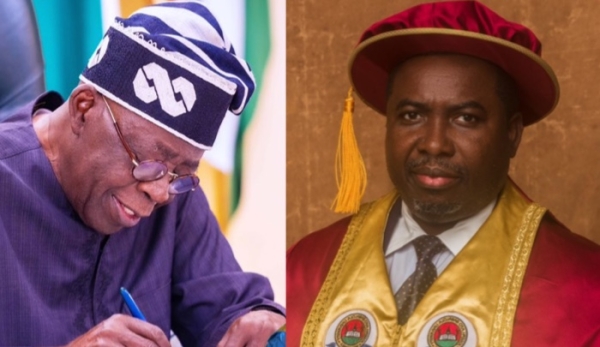
Let us pause to imagine, or rather, to sketch the portrait of this man now poised to orchestrate the 2027 general elections. Professor Amupitan is no faceless bureaucrat.
Picture a silver-haired legal titan in his late 60s, hailing from the dusty hills of Kogi State in Nigeria’s North-Central zone – a region long starved of the INEC top job, making his selection a cynical nod to “federal character” while ignoring the deeper rot.
He’s a product of the University of Jos, where he clawed his way from lecturer to Dean of the Faculty of Law, then to Deputy Vice-Chancellor (Administration). His CV gleams with academic polish: a PhD in Law, decades as Head of Public Law, and a stint as Pro-Chancellor at Joseph Ayo Babalola University.
On paper, he’s the archetype of the professorial INEC chair – think Attahiru Jega’s gravitas, minus the spine. But peel back the layers, and you find a man whose loyalty isn’t to the ballot box, but to the godfather who now elevates him.
Amupitan’s real claim to infamy? His role as a longtime legal counsel in the shadowy defense of Tinubu’s 2023 “victory.”
While the world watched in horror as glitches swallowed votes, servers crashed under mysterious loads, and results were uploaded from dark alleys rather than polling units, Amupitan was in the trenches.
Reports from the trenches of the Presidential Election Petition Tribunal paint him as a key player in the APC’s war room – not the lead bulldog like Wole Olanipekun, but a trusted insider, drafting briefs that twisted electoral law into pretzels to justify the unjustifiable.
He argued, with the cool precision of a surgeon, that the BVAS failures were mere “technical hiccups,” that opposition cries of rigging were sour grapes, and that Tinubu’s mandate was as ironclad as the Lagos-Ibadan Expressway (which, ironically, remains a pothole-riddled joke).
This was no neutral arbiter; this was a man who feasted on the carcass of a flawed election, helping to bury the evidence under mountains of legalese.
And now, Tinubu – the same man whose “mandate” he defended – nominates him to run the show for 2027. It’s like hiring the referee who fixed the last match to officiate the rematch. The conflict of interest isn’t just glaring; it’s a supernova.
Our democracy isn’t bending; it’s broken – shattered into shards that Tinubu’s broom can’t sweep away.
Recall 2023: a election so marred by INEC’s own admissions of “logistical challenges” that even the European Union observers called it a “significant regression.”
Votes vanished in the opposition strongholds of Lagos and Kano; thugs in APC-branded vests chased away voters in Rivers; and the Supreme Court, in a verdict that rang hollower than a campaign promise, upheld Tinubu’s win while ignoring the arithmetic of fraud.
Fast-forward to now, and Yakubu’s abrupt exit – forced, some whisper, after he dared to entertain new party registrations that might dilute APC dominance – feels less like retirement and more like a purge.
Enter Amupitan, stage right, with his impeccable robes and impeccable ties to the presidency. How can this man, who spent years gaslighting the nation on electoral integrity, suddenly become its guardian? It’s a farce that would make Molière blush.
This isn’t mere cronyism; it’s the architecture of autocracy.
In the Tinubu era, institutions that once flickered with independence – the judiciary, the legislature, now INEC – are being hollowed out, stuffed with loyalists who view democracy not as a sacred trust but as a family business.
The 2027 polls, already looming like a storm cloud over the Sahel, will be managed by a chairman whose every decision will echo with the question: “What would Jagaban want?” Will BVAS work this time, or will it “glitch” in the right places? Will results flow transparently, or will they trickle from the villa’s backrooms? Nigerians, already battered by naira nosedives and fuel queues, deserve better than a scripted sequel to 2023’s tragedy.
Yet, in the echo chamber of X (formerly Twitter), the reactions are a mixed bag – a testament to our fractured hope. Some hail Amupitan’s “merit,” with APC cheerleaders crowing about his academic pedigree and even opposition voices offering cautious “admonition” instead of outright fury.
Others seethe: “The protest that should be going on now is the nomination of Tinubu’s lawyer as INEC Chairman,” one user laments, capturing the quiet rage building in the streets.
Civil society groups like Situation Room urge Senate scrutiny, but let’s be real – with APC’s Senate supermajority, confirmation is a formality.
The decline isn’t hypothetical; it’s here, etched in every appointment that prioritizes fealty over fairness.
Tinubu rode into power on whispers of “renewed hope,” but this is renewed despair.
If Amupitan takes the helm, 2027 won’t be an election; it’ll be a coronation.
And when the votes are tallied – or tallied away – we’ll look back at this moment as the day democracy didn’t just stumble, but was pushed off the cliff.
Nigerians, the ballot is our last stand. Organize, litigate, protest – before the man who defended the rig becomes the one who rigs it anew. Our republic hangs by a thread, and it’s fraying fast.
Pamela.O is a Lagos-based political columnist and author of “Shadows of the Ballot: Nigeria’s Electoral Nightmares.”