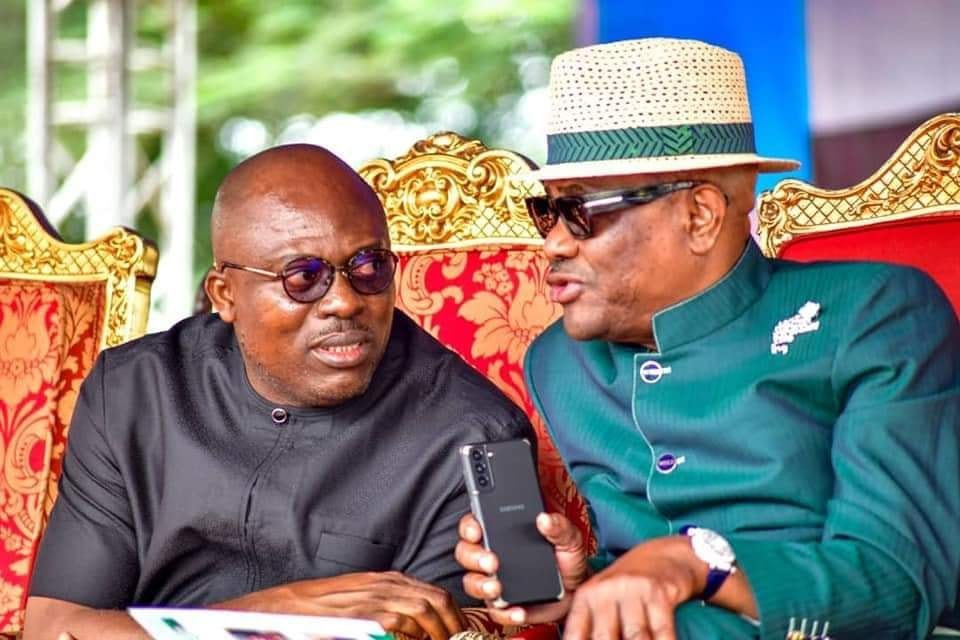
In the humid late afternoon of October 18, the private residence of Rivers State Governor Siminalayi Fubara once again became the stage for a familiar Nigerian political ritual.
Nyesom Wike, the FCT Minister and the man who midwifed Fubara’s rise, arrived with a full entourage—APC governorship candidate Kingsley Chinda, members of the State House of Assembly, local government chairmen, and assorted Rainbow Coalition heavyweights.
Closed doors, no communiqué, another “reconciliation” meeting. It was the second such gathering in roughly two weeks.
On the surface, it is peace after war. Beneath the surface, it is the classic arithmetic of godfather politics: the structure still needs the man it once elevated, even after deciding he should not continue in office.
The history is well known. Wike installed Fubara in 2023. The relationship collapsed into open conflict—legislative warfare, court battles, and eventually a state of emergency declared by President Tinubu in 2025.
When the emergency lifted, Fubara’s second-term path had already narrowed to nothing. He has now publicly declared he will not seek re-election, returned to what he calls “our family,” and endorsed Chinda as the candidate of the Rainbow Coalition while pledging support for Tinubu.
Wike, for his part, has spoken of forgiveness and of Fubara being “happy” with the new arrangement.
Yet the optics of the past fortnight remain striking. Wike is leading delegations to the governor’s house. The sitting governor’s residual influence—his control of the state apparatus for the remaining months, his loyalists on the ground, and the simple fact that he still occupies Government House—still matters enough to warrant repeated, high-level visits.
In the blunt language of Rivers politics, the man whose continuation as governor was deemed unacceptable is nonetheless required to help make the next man governor.
This is not unique to Rivers. Nigerian political history is littered with similar settlements: a governor is prevented from seeking a second term or is weakened, only for the same structure to discover that discarding him entirely risks a split vote or an uncontrolled succession.
The calculation is rarely about personal affection. It is about turnout, ward structures, and the fear that an aggrieved incumbent, even a lame-duck one, can still complicate the arithmetic in 2027.
Fubara’s public return to the fold and his instruction to supporters to back Chinda and the coalition are therefore valuable currency. They reduce the risk of a three-way contest or a protest vote from people who still see him as their champion.
Critics will call the meetings begging. Defenders will call them mature realignment. Both descriptions can be true at once.
Wike retains the larger political machine and the federal leverage that comes with his portfolio and his relationship with the centre.
Fubara retains the constitutional powers of a sitting governor and whatever grassroots loyalty survives the earlier conflict.
Neither is in a position of pure strength or pure weakness. The closed-door sessions are the negotiation of that residual leverage—how much public endorsement, how much mobilisation of the SIMplified Movement, how much silence on past grievances, and in exchange for what post-2027 assurances.
For Rivers people, the practical question is narrower. Will the truce hold long enough for the state to have a functional relationship between the executive and the legislature in the months ahead? Or is this merely a temporary ceasefire designed to deliver a particular outcome in 2027, after which the old fault lines reappear under new names? History in the state suggests caution.
Previous peace deals have frayed once the immediate political objective was secured or abandoned.
The larger irony remains. A political arrangement that judged Fubara unsuitable to continue as governor has still concluded that his active cooperation is useful in choosing and installing his successor.
In the logic of Rivers politics, that is not a contradiction. It is the system working exactly as it was designed.
-Daily Buzzwire
About the Author