In the theatre of Nigerian politics, where loyalty shifts faster than the harmattan wind, Senator Enyinnaya Abaribe’s recent defection from the All Progressives Grand Alliance to the African Democratic Congress has become more than a routine party switch. It has exposed the raw underbelly of a constitutional framework that, in its silence on a critical matter, invites selective interpretation and political vendetta.
Section 68(1)(g) of the 1999 Constitution (as amended) is unambiguous in its intent: a legislator whose election was sponsored by a political party vacates their seat upon becoming a member of another party before the term’s end—unless the move stems from a verifiable division within the original party or a merger of parties. The provision’s two narrow exemptions are clear.
Yet the Constitution remains conspicuously silent on what happens when a legislator is expelled, suspended, or otherwise “sacked” by their sponsoring party.
No clause addresses the limbo created when a lawmaker is forcibly severed from their platform, left without affiliation in a system that demands party membership under Section 65.
This gap is not a minor oversight; it is a structural vulnerability. When the law says nothing about a scenario, logic dictates that no penalty can be imposed for it. Nulla poena sine lege—no punishment without law—remains a cornerstone of legal reasoning. To declare a seat vacant based on expulsion, an event the Constitution does not contemplate in its defection rules, amounts to reading into the text what is absent.
Abaribe’s claim of having been expelled from APGA in September 2025 places him precisely in this gray zone. If the expulsion stands (and he has asserted possession of the letter), he was already detached from APGA before formally aligning with ADC.
In such circumstances, seeking refuge in another party becomes not defiance of the Constitution but compliance with the requirement to belong to a political party at all times.
Adding striking irony to the Senate’s current posture is a precedent involving none other than Senate President Godswill Akpabio himself.
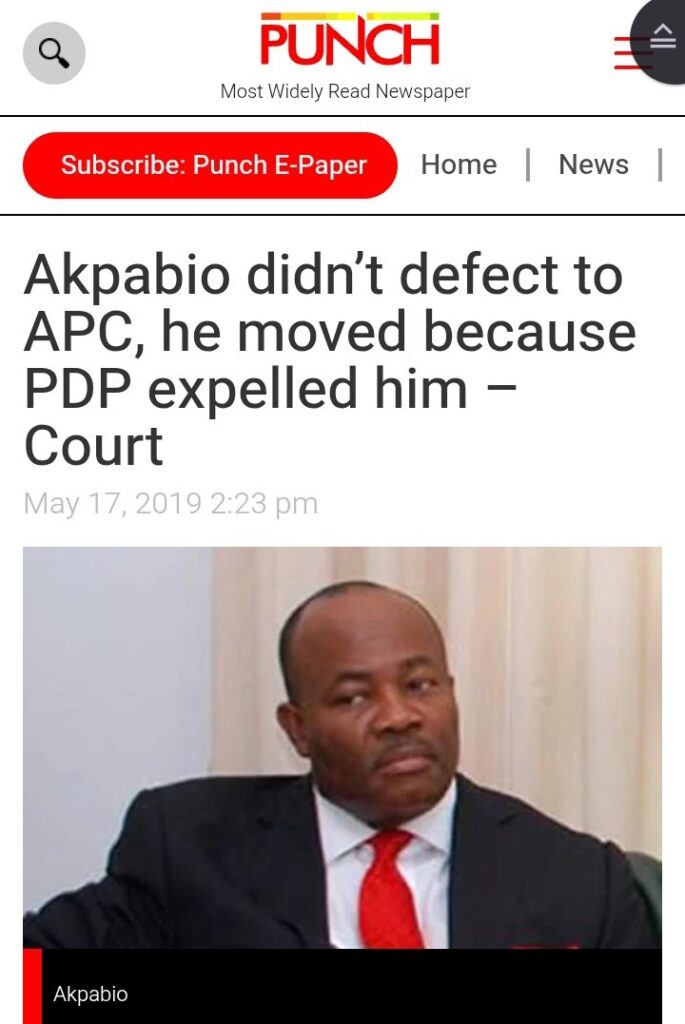
In May 2019, a Federal High Court in Abuja ruled in a defection suit that Akpabio did not “defect” from the Peoples Democratic Party to the All Progressives Congress in 2018; rather, he “moved” because the PDP had expelled him.
The court, presided over by Justice Okon Abang, held that Section 68(1)(g) did not apply, as expulsion rendered Akpabio free to join another party without triggering vacancy.
The judge emphasized that punishing him for exercising his freedom of association under Section 40 would be unconstitutional, based on evidence of expulsion tendered in court. This ruling dismissed attempts to vacate his seat, affirming that forced removal by the party created a different legal reality from voluntary defection.
Yet today, the same Senate leadership—now headed by Akpabio—threatens Abaribe with vacancy over a parallel claim of expulsion from APGA, demanding proof within days while framing the move as an unexempted defection.
The parallel is unmistakable: what was once judicially validated as a legitimate path for one prominent figure is now treated as grounds for sanction against another. This selective application undermines the consistency that law demands and fuels perceptions of vendetta over jurisprudence.
The Senate’s response—granting a one-week ultimatum for proof of expulsion, with the threat of vacancy looming—reveals more about power than principle.
While other defections announced on the same plenary floor drew little scrutiny, Abaribe’s has sparked a constitutional spectacle.
The leadership’s insistence on “no division” in APGA ignores the expulsion angle entirely, treating it as a standard defection despite the unique facts. This selective enforcement is no accident. Abaribe has long been a thorn in the side of executive overreach, consistently demanding accountability on electoral integrity, fiscal responsibility, and governance failures.
His vocal opposition has made him a target, and the current pressure appears calibrated to silence one of the few remaining checkmates in the chamber.
The path forward is straightforward: amend the Constitution. Introduce a clear provision—perhaps as an additional proviso to Section 68—specifying the consequences of expulsion. Options abound: treat expulsion as equivalent to voluntary defection and mandate vacancy; allow the expelled legislator to retain their seat as an independent pending fresh affiliation; or require judicial verification to prevent abuse.
Any of these would close the loophole and prevent future exploitation of ambiguity. Until then, the silence protects Abaribe’s position more than it endangers it.
Nigerians have watched too many cycles of political musical chairs where rules bend for allies and stiffen for adversaries.
Abaribe’s case tests whether the system can rise above transactional expediency. If the Senate truly values constitutional fidelity over factional score-settling, it will let evidence speak rather than ultimatums.
And if the goal is genuine reform, lawmakers should turn their energy toward patching the very gap they now exploit—especially when past rulings on similar facts favored leniency for those now wielding the gavel.
In the end, democracy in Nigeria will mature not through selective enforcement of incomplete laws, but through honest amendment and consistent application. Until that day, figures like Abaribe—who dare to speak truth to power—deserve the nation’s solidarity, not its suspicion.
The game is exposed; the question is whether anyone will change the rules.
Pamela O. political columnist, analyst and commentator.

Never lose your keys, wallet or bag again
• Works with iPhone Find My
• Precision finding + sound
• Replaceable battery lasts 1+ year
Buy now → https://www.amazon.com/dp/B0933BVK7Q?tag=gadgets00139-20

About the Author